One-Minute Summary
Your crawlspace is not a passive void — it actively exchanges air, moisture, and heat with every room above it. The stack effect pulls 40-50% of first-floor air from below. Four moisture mechanisms (bulk water, capillary action, air transport, and vapor diffusion) move water into the crawlspace continuously. Vapor pressure differential drives ground moisture upward even without rain. When surface temperatures drop below the dew point, condensation forms — and in Midwest summers, vented crawlspaces reach 77% humidity while sealed ones hold at 52%. The research is clear: sealed, conditioned crawlspaces outperform vented designs in humidity control, energy efficiency, and indoor air quality.
In This Article
- The Stack Effect: How Crawlspace Air Enters Your Home
- The Neutral Pressure Plane
- Four Moisture Transport Mechanisms
- Vapor Pressure Differential
- Why Vented Crawlspaces Fail in Humid Climates
- The Advanced Energy Study: Data Comparison
- HVAC Interaction and Duct Leakage
- Dew Point and Condensation
- Kansas City and Des Moines Climate Factors
Section 1 of 9
The Stack Effect: How Crawlspace Air Enters Your Home
The stack effect is the primary driver of air movement between your crawlspace and your living space. Warm indoor air is less dense than cool air, so it rises and escapes through gaps in the ceiling, attic, and roof assembly. As it exits upward, replacement air is drawn in from the lowest available opening — your crawlspace.
Key Data Point
40-50% of first-floor air originates from the crawlspace through the stack effect
Building science research quantifies this clearly. In unsealed crawlspaces in Kansas City and Des Moines, where summer humidity regularly reaches 75-85%, this means homeowners breathe crawlspace air — including mold spores, allergens, and moisture — every day from May through September.
How the Stack Effect Moves Crawlspace Air Into Your Home
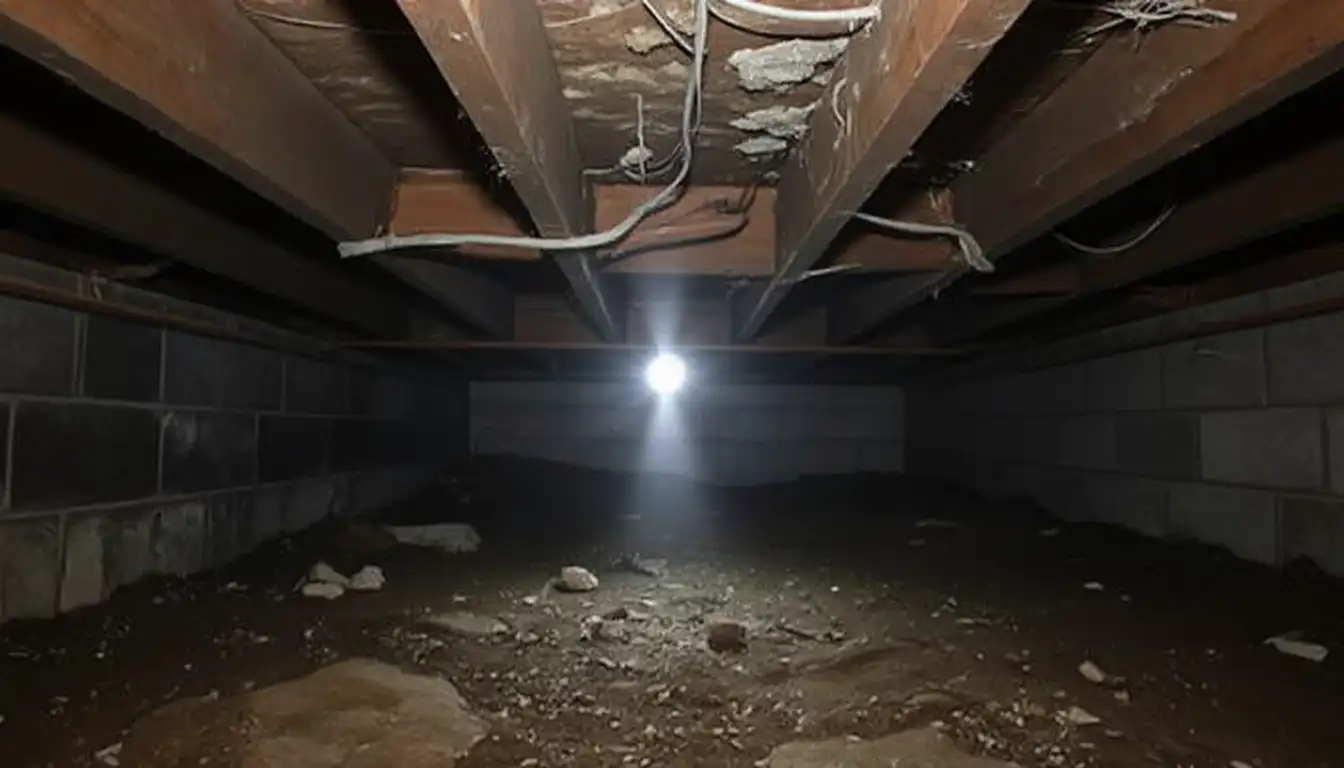
The intensity scales with temperature difference. During a Kansas City January at 20°F outdoors and 70°F indoors, the 50-degree differential creates substantial upward pressure. Air velocity through floor penetrations — plumbing chases, electrical runs, HVAC supply boots — increases proportionally with that temperature gap.
Summer reverses the direction but not the problem. When outdoor air is warmer than conditioned indoor air, the stack effect can invert. However, the dominant pathway in most Midwest homes remains upward infiltration because air conditioning creates negative pressure on upper floors through return duct leakage. The net result: year-round crawlspace air entering your living space. Understanding the symptoms this creates helps connect the physics to what you actually experience.
Check Your Understanding
If 40-50% of your first-floor air comes from the crawlspace, and your crawlspace has 80% relative humidity and active mold growth, what is happening to your indoor air quality?
Reveal Answer
Your living space is continuously receiving humid, mold-spore-laden air from below. The stack effect transports moisture, volatile organic compounds (musty smells), and allergens directly into your breathing zone. This is why musty odors persist even after cleaning — the source is below the floor, not in the living space.
Section 2 of 9
The Neutral Pressure Plane: Where Crawlspace Air Enters Your Home
The neutral pressure plane is the elevation where indoor and outdoor air pressures are equal. Below it, your home is under negative pressure — pulling air inward from the crawlspace. Above it, positive pressure pushes air outward through upper-level cracks and attic penetrations. In a typical two-story home with a crawlspace, this plane sits roughly at the midpoint of the first floor.
Building Science Principle
The neutral pressure plane divides your home into intake (below) and exhaust (above) zones — your crawlspace sits entirely in the intake zone
Everything below the neutral pressure plane acts as an intake zone. Every gap in the floor assembly — rim joist connections, plumbing penetrations, ductwork boots, electrical chases — becomes an entry point for crawlspace air. Temperature difference alone creates the driving force, making infiltration continuous and automatic.
Two approaches address this problem. Sealing the floor assembly air barrier (spray-foaming rim joists, caulking penetrations, sealing duct connections) disconnects the crawlspace from the intake zone, reducing air exchange by 70-90%. Alternatively, encapsulating the crawlspace moves the pressure boundary to the crawlspace walls, eliminating the floor as a pressure boundary entirely.
Exhaust fans shift the neutral pressure plane downward. Range hoods, bathroom fans, and dryer vents remove living-space air and increase negative pressure on lower floors. The neutral pressure plane drops, expanding the intake zone and amplifying crawlspace infiltration during operation. The complete crawlspace guide explains how these mechanical factors interact with natural air movement.
Section 3 of 9
Four Moisture Transport Mechanisms in Crawlspaces
Four distinct mechanisms move moisture into and through a crawlspace, each at different rates and requiring different interventions:
| Mechanism | How It Works | Volume | Primary Fix |
|---|---|---|---|
| Bulk water | Rain/groundwater enters through foundation cracks or poor grading | Highest (hundreds of gallons per event) | Drainage, grading, waterproofing |
| Capillary action | Water wicks upward through porous concrete and masonry | Moderate, continuous | Capillary break, vapor barrier |
| Air-transported moisture | Humid air moves through floor penetrations via stack effect | 50-100x greater than vapor diffusion | Air sealing |
| Vapor diffusion | Water molecules pass through solid materials driven by vapor pressure | Slowest but most persistent | Vapor barrier (6-mil poly reduces 95%) |
The Four Moisture Transport Mechanisms in Your Crawlspace
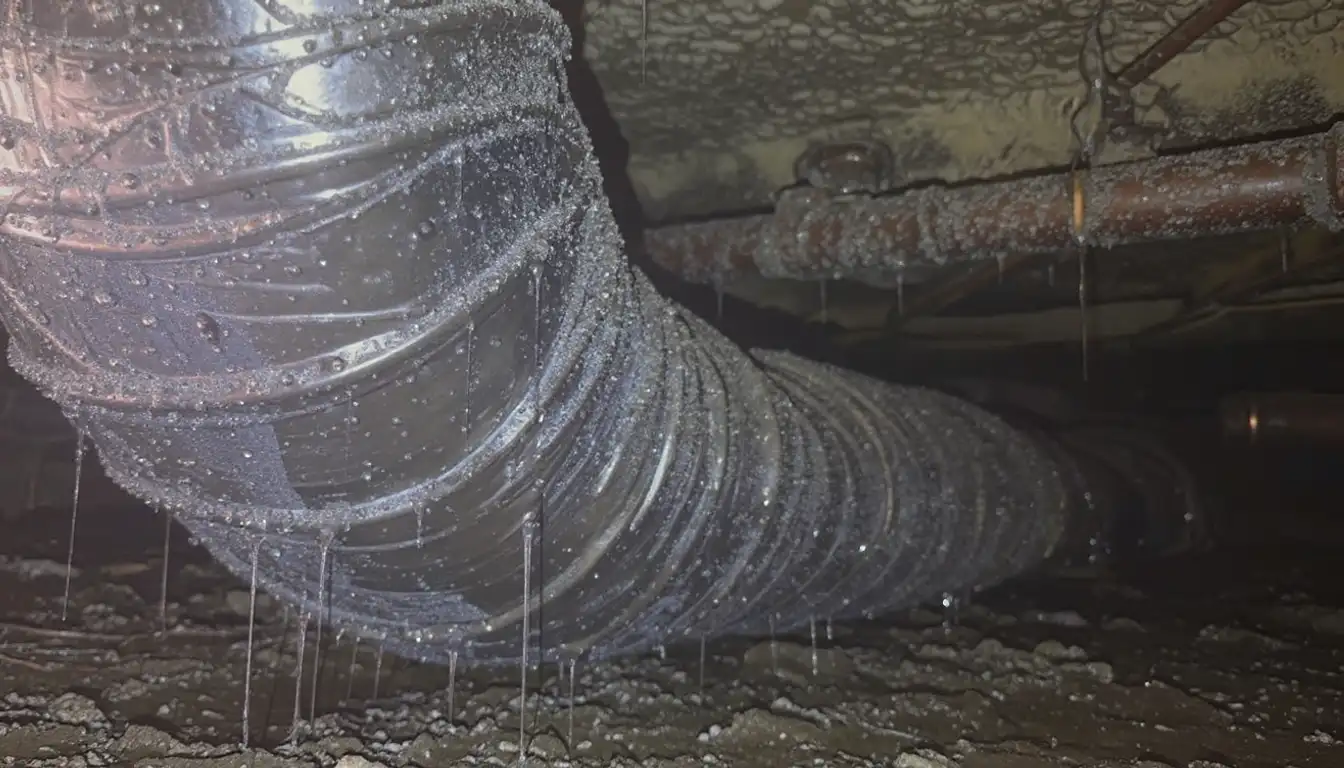
Condensation forms when warm humid crawlspace air contacts cold HVAC ductwork surfaces — visible evidence of the dew point mechanism that drives moisture damage.
Air-transported moisture is the dominant mechanism in most climates. A single one-inch-diameter hole in the subfloor transports more moisture per day than 30 square feet of bare concrete through diffusion alone. This is why sealing air leaks is more effective than adding insulation or ventilation.
Research Finding
Exposed soil in a 1,000 sq ft crawlspace emits 10-15 gallons of moisture per day through evaporation and diffusion
Identifying which mechanisms are active determines which repair methods will be effective. A crawlspace with bulk water requires drainage solutions before vapor barriers will perform. A dry crawlspace with high humidity is likely experiencing vapor diffusion from exposed soil and air-transported moisture from vents. Matching the intervention to the active mechanism prevents ineffective repairs.
Check Your Understanding
A homeowner's crawlspace has no standing water and no plumbing leaks, but humidity consistently reads 78%. Which moisture transport mechanisms are most likely responsible?
Reveal Answer
Vapor diffusion from exposed soil (10-15 gallons/day from 1,000 sq ft) and air-transported moisture entering through foundation vents. Without visible water, bulk water and capillary action are less likely. The fix: install a vapor barrier over exposed soil and seal foundation vents to cut off both sources.
Section 4 of 9
Vapor Pressure Differential: Why Ground Moisture Never Stops
Vapor pressure differential is the force that moves moisture from soil into crawlspace air without any visible water. Soil beneath a home is nearly always at or near 100% relative humidity. Crawlspace air, even at 70-80% RH, has lower vapor pressure than saturated soil. That difference drives continuous water molecule flow upward — day and night, regardless of season.
Common Misconception
Myth: "Crawlspace moisture only comes from rain or groundwater. If it hasn't rained, the crawlspace should be dry."
Reality: Even well-drained soils with no visible standing water maintain near-100% relative humidity at the soil surface beneath a home. The vapor pressure differential between this perpetually moist soil and the crawlspace air above it drives moisture upward continuously. Rainfall is just one of four moisture sources — and often not the largest one.
The rate depends on two factors: the magnitude of the pressure differential and the permeability of materials between soil and air. Bare soil presents essentially no resistance — 10-15 gallons per day from 1,000 sq ft during warm months. Poured concrete reduces but does not eliminate transport because concrete is porous at the molecular level. Only a properly installed polyethylene vapor retarder creates meaningful resistance.
Temperature amplifies the effect. Warmer soil produces higher vapor pressures. During a Kansas City July, soil temperatures beneath a home reach 65-70°F, and the absolute moisture content of saturated soil vapor is substantially higher than in winter. Combined with 75-85% outdoor humidity, summer creates the highest vapor pressure differentials and greatest moisture loading on crawlspaces.
Clay-heavy soils amplify it further. Kansas City (Missouri River basin clay) and central Iowa (glacial till) retain more moisture at shallow depths because clay particles hold water tenaciously. The vapor pressure differential in these markets is higher than in sandy or well-drained soils.
Worked Example: Vapor Drive in a Kansas City Crawlspace
Scenario: A 1,200 sq ft crawlspace with exposed soil. July conditions. Soil temperature: 67°F (near 100% RH at soil surface). Crawlspace air: 75°F, 72% RH.
Vapor pressure at soil surface: At 67°F and 100% RH, saturation vapor pressure is approximately 0.65 inches of mercury (inHg).
Vapor pressure in crawlspace air: At 75°F and 72% RH, vapor pressure is approximately 0.63 inHg.
Result: The differential is small but persistent — and with 1,200 sq ft of exposed soil acting as the source, even this modest differential moves 12-18 gallons of water vapor per day into the crawlspace. A 6-mil polyethylene vapor barrier reduces this by approximately 95%, cutting daily moisture input to under 1 gallon.
Section 5 of 9
Why Vented Crawlspaces Fail in Humid Midwest Climates
Vented crawlspace design assumes outdoor air will dilute and remove moisture. In arid climates, this works. In Kansas City and Des Moines, where outdoor dew points regularly exceed 65°F from June through August, venting introduces more moisture than it removes.
The problem is thermodynamic. When 85°F outdoor air at 80% RH enters a crawlspace where surfaces are 65-70°F, that air cools rapidly. Cooler air holds less moisture, so relative humidity rises as temperature drops. By the time the air contacts cool foundation walls and ductwork, it can reach 95-100% RH — producing condensation on every surface below the dew point. Venting does not dry the crawlspace; it actively wets it.
Common Misconception
Myth: "Opening foundation vents in summer will help dry out a damp crawlspace."
Reality: In humid climates, opening vents does the opposite. Hot, humid outdoor air cools when it enters the crawlspace, and its relative humidity rises — often to condensation levels. The Advanced Energy study measured 77% average RH in vented crawlspaces vs. 52% in sealed ones. Ventilation is the moisture problem, not the solution.
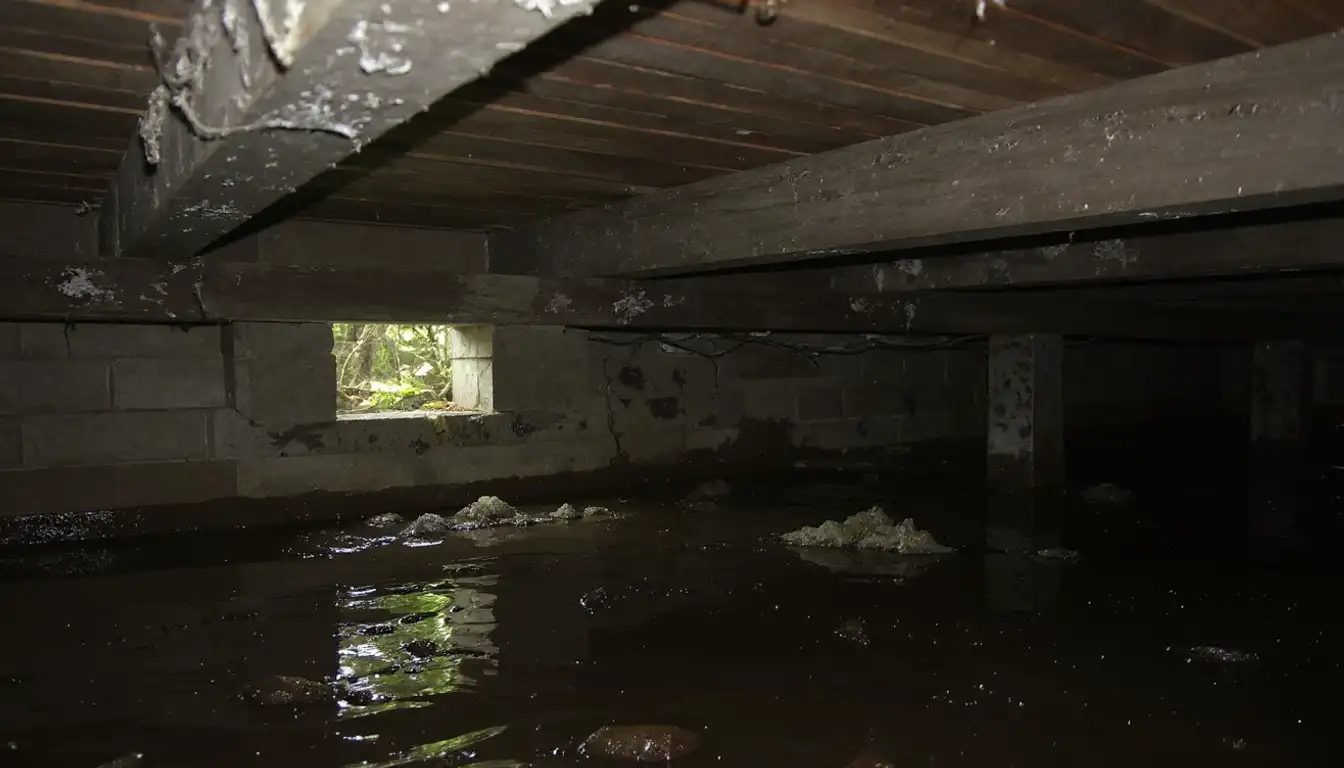
Vented crawlspace: 77% avg. humidity
Sealed crawlspace: 52% avg. humidity
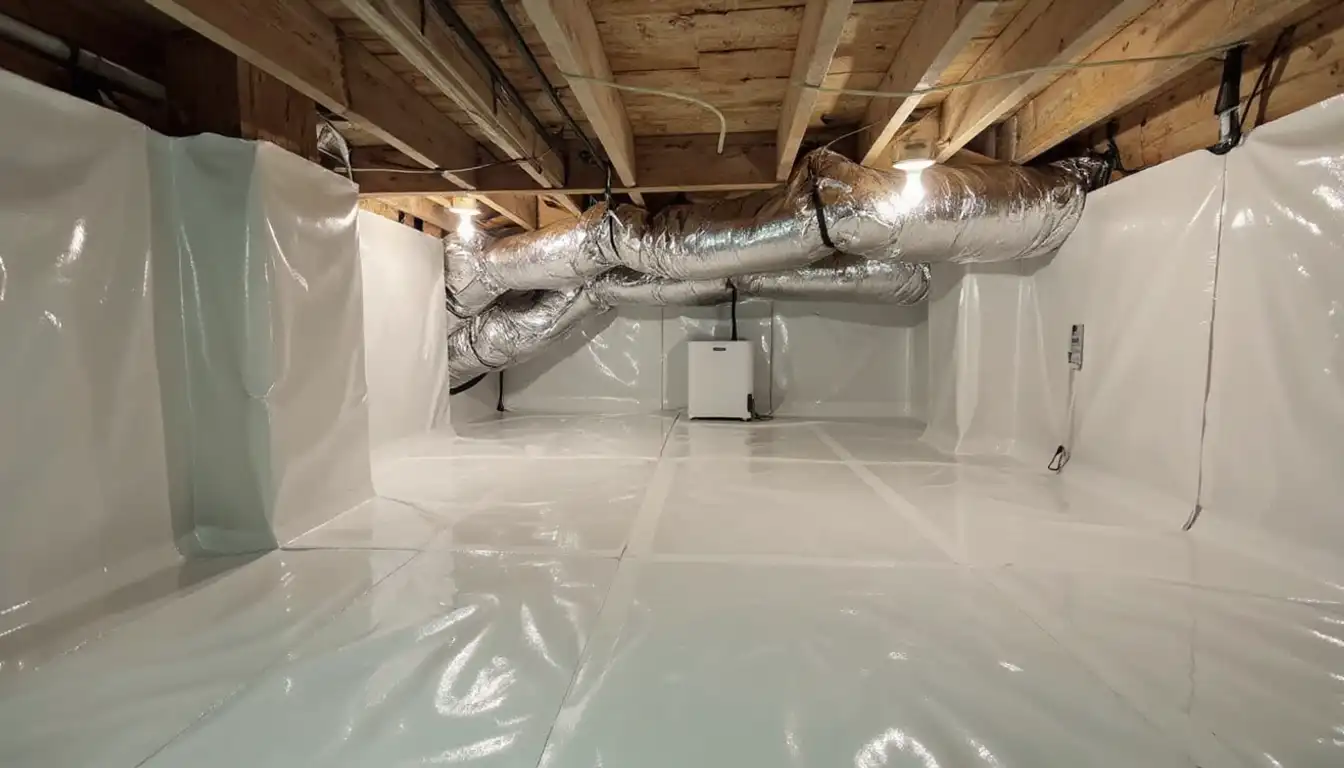
Mold growth begins within 24-48 hours above 60% RH. Sealed crawlspaces maintain average humidity of 52% — well below the mold threshold. Vented crawlspaces average 77% — guaranteed mold colonization territory.
The IRC now permits sealed crawlspaces (Section R408.3), reflecting decades of field data. Requirements include a continuous vapor retarder, mechanical ventilation or conditioned air supply, and a sealed perimeter. Both Kansas City and Des Moines jurisdictions accept sealed designs, though many older homes were built with foundation vents under earlier codes.
Important: closing vents without addressing the complete system creates new problems. Simply blocking foundation vents traps ground moisture with no exit path, potentially making conditions worse. Effective conversion requires a full approach — vapor retarder, sealed vents, and either dehumidification or conditioned air supply. The methods page details the conversion steps.
Section 6 of 9
The Advanced Energy Study: Sealed vs. Vented by the Numbers
The Advanced Energy sealed crawlspace field study is the most comprehensive controlled comparison ever conducted — approximately 100 homes monitored for temperature, humidity, energy use, wood moisture content, and air quality over multiple years.
| Metric | Sealed Crawlspace | Vented Crawlspace |
|---|---|---|
| Average relative humidity | 52% (below mold threshold) | 77% (above mold threshold) |
| Wood moisture content | 10-14% (safe range) | 19%+ (decay fungi active) |
| Energy savings | 10-30% reduction in heating/cooling | Baseline |
| Duct leakage impact | 300+ CFM stays within conditioned space | 300+ CFM lost to outdoor air |
| Indoor mold spore counts | Significantly reduced | Elevated |
| Radon levels | Decreased (controlled air exchange) | Variable |
Energy improvements came from two sources: eliminating the thermal penalty of introducing unconditioned outdoor air through vents, and reducing duct leakage losses by placing ductwork inside the conditioned boundary. The average home had over 300 CFM of duct leakage — air heated or cooled and then lost to the crawlspace.
Indoor air quality improved measurably. Airborne mold spore counts in living spaces dropped significantly when crawlspaces were sealed, consistent with the stack effect delivering cleaner air from a controlled below-grade environment. These findings influenced IRC code changes and DOE recommendations for foundation treatment.
Section 7 of 9
How Crawlspace Conditions Affect Your HVAC System
Most Midwest homes built before 2000 have ductwork, air handlers, or both in the crawlspace. When that space is unconditioned, every HVAC component operates in a hostile environment — losing heat in winter, gaining it in summer, and leaking conditioned air year-round.
Supply duct leakage wastes conditioned air. A 300 CFM leak on a system moving 1,200 CFM means 25% of output is lost. In a vented crawlspace, that air exits through foundation vents. In a sealed crawlspace, leaked air stays within the conditioned boundary — converting a loss into crawlspace temperature stability.
Return duct leakage is worse for air quality. Leaky return ducts pull crawlspace air — mold spores, moisture, soil gases — directly into the HVAC system and distribute it to every room through supply registers. This bypasses the stack effect entirely with mechanical transport.
Condensation on ductwork occurs when cold supply ducts (55°F air) pass through a crawlspace at 75°F and 80% RH. Water forms on duct surfaces, drips onto framing, and creates sustained wet conditions. Duct insulation absorbs water and loses thermal performance.
Energy Impact
DOE research: duct losses in unconditioned crawlspaces account for 25-40% of total HVAC energy consumption. Sealing the crawlspace reduces this by bringing ducts inside the thermal envelope.
Section 8 of 9
Dew Point Temperature: Predicting When Condensation Forms
Dew point temperature is the single most useful metric for predicting crawlspace condensation. Unlike relative humidity (which changes with temperature), dew point is an absolute measure of moisture in air. When any surface drops to or below the air's dew point, water condenses on that surface.
Condensation requires no rain or plumbing leak. On a July day in Kansas City with outdoor air dew point of 72°F, a 62°F foundation wall produces continuous condensation. Ventilation makes it worse — every cubic foot of outdoor air carries that 72°F dew point into contact with 62°F surfaces.
Why Summer Is Worse
Winter air dew points (15-25°F) sit well below crawlspace surface temperatures — condensation is essentially impossible. Summer dew points (65-75°F) routinely exceed them — making condensation frequent from May through September.
Worked Example: Will Condensation Form?
Scenario: Kansas City, July 15. Outdoor conditions: 87°F, 74% RH. Crawlspace foundation wall temperature: 63°F (from ground contact). Crawlspace air has reached equilibrium with outdoor conditions through open foundation vents.
Step 1 — Find the dew point: At 87°F and 74% RH, the dew point is approximately 78°F.
Step 2 — Compare to surface temperature: The foundation wall is 63°F. The dew point (78°F) is 15 degrees above the wall temperature.
Result: Condensation will form continuously on the foundation wall, ductwork, cold water pipes, and any other surface below 78°F. At a 15-degree spread, condensation is heavy and sustained. This is why summer "sweating" in crawlspaces has nothing to do with rain — it is psychrometric physics.
Prevention: Maintaining crawlspace air below 55% RH at typical temperatures keeps the dew point well below surface temperatures, eliminating condensation entirely.
Monitoring dew point provides early warning. A simple temperature and humidity sensor can calculate dew point. When crawlspace air dew point approaches the temperature of the coldest surface (usually the foundation wall or cold water pipe), condensation is imminent. The cost analysis page covers the economics of dehumidification systems that maintain safe conditions.
Check Your Understanding
A homeowner measures crawlspace air at 70°F and 65% RH (dew point: approximately 57°F). The coldest surface in the crawlspace is a cold water pipe at 54°F. Will condensation form? Where?
Reveal Answer
Yes, condensation will form on the cold water pipe. The pipe surface (54°F) is below the air's dew point (57°F), so moisture will condense on the pipe. However, other surfaces above 57°F (foundation walls at 60°F, floor joists at 68°F) will stay dry. This is a targeted condensation problem — insulating the pipe or reducing crawlspace humidity below ~50% would eliminate it.
Interactive Tool
Crawlspace Condensation Simulator
Use the sliders below to model your crawlspace conditions. Try recreating the worked example above (87°F outdoor temp, 74% RH, 63°F wall temp) to see the condensation prediction.
Adjust temperature, humidity, and soil type to see when condensation forms.
Crawlspace Condensation Simulator
Adjust outdoor conditions and crawlspace temperature to see how moisture risk changes.
Input Variables
Cross-Section View
Calculated Results
Section 9 of 9
Kansas City and Des Moines: Why These Climates Are Especially Hard on Crawlspaces
Both cities combine high summer humidity with deep winter frost — a dual stress that most generic advice does not address. Summer outdoor RH routinely reaches 75-85% with sustained dew points above 70°F for weeks. Winter brings frost depths of 36 inches (KC) and 42 inches (Des Moines), creating freeze-thaw cycling that affects foundation walls and moisture migration.
| Climate Factor | Kansas City | Des Moines |
|---|---|---|
| Summer outdoor RH | 75-85% | 75-85% |
| Frost depth | 36 inches | 42 inches |
| Summer dew points | 65-75°F | 65-75°F |
| Dominant soil type | Missouri River basin clay | Glacial till (high clay) |
| Condensation season | May-September | May-September |
Kansas City vs. Des Moines: How Local Soil and Climate Shape Crawlspace Risk
Summer conditions make vented crawlspaces particularly ineffective. When 88°F air at 78% RH enters a crawlspace where surfaces are 64°F, it reaches 100% RH and deposits liquid water on every surface at or below that temperature. Ventilation actively wets the crawlspace during the months moisture risk is highest.
Winter creates a different challenge. Freezing temperatures cause soil around the foundation to contract, creating micro-gaps. Spring thaw saturates these gaps with snowmelt, pushing water against the foundation. The deeper frost penetration in Des Moines extends this cycle later into spring and increases its severity.
Effective management requires year-round control. A system designed only for summer dehumidification won't address winter heat loss. A system designed only for winter thermal performance won't prevent summer condensation. The combination of sealed perimeter walls, continuous vapor retarder, frost-depth-appropriate insulation, and mechanical dehumidification addresses both extremes. Regional crawlspace improvement strategies must account for the full annual range of conditions.
What You've Learned — and Where to Go Next
Key Takeaways
- Stack effect: 40-50% of first-floor air comes from below — continuously, year-round
- Moisture transport: Four mechanisms operate simultaneously; air transport moves 50-100x more moisture than diffusion
- Vapor pressure: Ground moisture enters the crawlspace 24/7, even without rain
- Dew point: Summer condensation is psychrometric physics, not a plumbing problem
- Sealed vs. vented: 52% RH vs. 77% RH — the data is unambiguous
- HVAC: Duct leakage in unconditioned crawlspaces wastes 25-40% of energy
Recommended Next Steps
- Read the Complete Crawlspace Guide — comprehensive overview connecting science to solutions
- Identify Your Symptoms — connect what you're experiencing upstairs to the crawlspace conditions causing it
- Compare Repair Methods — understand which interventions target which mechanisms
- Understand the Costs — investment ranges and ROI timelines for crawlspace improvement