Section 1 of 8
Diagnose: What's Causing Your Cold Floors?
Use this table to match what you're experiencing to its most likely crawlspace cause. Most homes have more than one factor — that's normal.
| What You Notice | Most Likely Cause | Urgency |
|---|---|---|
| Entire first floor feels cold, thermostat reads 70°F | Uncontrolled crawlspace temp + air infiltration through floor assembly | Moderate — comfort and energy issue |
| Cold strips every 16 inches across the floor | Thermal bridging at floor joists — insulation missing or displaced | Moderate — insulation has failed |
| Cold band along all exterior walls | Rim joist air infiltration — uninsulated and unsealed perimeter | High — largest single infiltration source |
| Some rooms noticeably colder than others | Inconsistent insulation — batts fallen or compressed in some joist bays | Moderate — partial insulation failure |
| Cold floor + musty smell from below | Moisture problem driving both heat loss and mold activity | High — air quality + comfort issue |
| Floors cold + energy bills rising each winter | Progressive insulation degradation + duct leakage into crawlspace | High — compounding energy waste |
Self-Assessment: Walk Your First Floor Barefoot
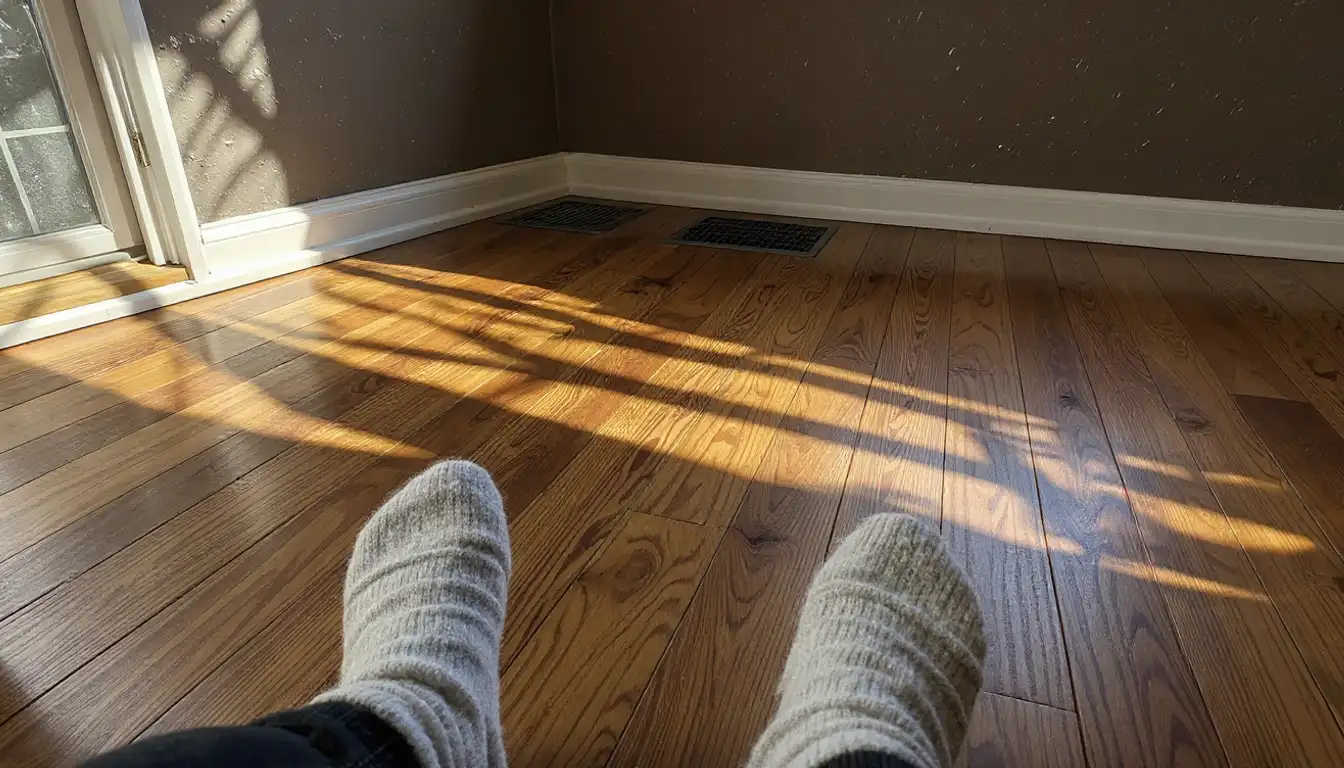
Walk slowly through every first-floor room without socks. Note:
- Is the cold uniform or concentrated in specific rooms?
- Can you feel parallel cold strips about 16 inches apart? (thermal bridging at joists)
- Is the perimeter — within 2 feet of exterior walls — colder than the room center?
- Are rooms above bathrooms, kitchens, or the HVAC unit warmer? (duct heat loss)
What your answers tell you: Uniform cold = whole-crawlspace issue (temp + air infiltration). Localized cold = specific insulation failure or concentrated leakage. Perimeter cold = rim joist is the priority target.
Section 2 of 8
Severity Assessment: How Bad Is Your Cold Floor Problem?
The gap between your thermostat reading and your floor surface temperature tells you where you fall. You can measure floor surface temp with an infrared thermometer ($15-25 at any hardware store).
| Severity Level | Floor-to-Air Temp Gap | What It Means | Recommended Action |
|---|---|---|---|
| Mild | 5-8°F below thermostat | Some insulation degradation; minor air leaks | Air-seal rim joist; check insulation condition |
| Moderate | 8-12°F below thermostat | Significant insulation failure or major infiltration | Insulation replacement + air sealing; inspect crawlspace |
| Severe | 12-15+°F below thermostat | Minimal effective insulation; crawlspace near outdoor temp | Full crawlspace assessment — likely needs encapsulation |
Key Data Point
Floor surface temperatures can be 10-15°F lower than thermostat readings when the crawlspace below is unconditioned. A room reading 70°F at the thermostat may have a floor surface of 55-60°F.
Section 3 of 8
How the Stack Effect Creates a Cold Floor Feedback Loop
The stack effect drives a continuous exchange of crawlspace air into your living space. During heating season, warm air inside your home rises and exits through the upper envelope — attic penetrations, recessed lights, top plates of interior walls. As that warm air leaves from above, replacement air is drawn upward from the lowest available source: your crawlspace. Research consistently shows that 40 to 50 percent of the air on a home's first floor originates from the crawlspace through the stack effect.
Cold crawlspace air enters through every gap in the floor assembly. Plumbing penetrations, electrical wire holes, HVAC supply boot connections, and the rim joist perimeter all serve as entry points. This infiltrating air is at crawlspace temperature — typically 35 to 45°F in a Midwest winter — and it flows across the underside of the subfloor before rising into the living space, actively stripping heat from the floor above.
The rim joist is the single largest contributor to cold floors. The rim joist perimeter — where the floor framing sits on the foundation wall — is often the least insulated and least sealed component. Gaps between the sill plate, rim joist, and subfloor allow cold air to flow directly into joist bays, creating a band of cold floor along every exterior wall.
Building Science Principle
40-50% of first-floor air originates from the crawlspace — carrying cold air that strips heat from the subfloor as it rises
The feedback loop: Colder outdoor air → colder crawlspace → greater temperature difference → stronger stack effect → more cold air pulled upward → colder floors → thermostat increased → more warm air exits upper envelope → even more cold air pulled from crawlspace. The coldest days produce the coldest floors, and no thermostat setting breaks this cycle.
Common Misconception
"Cold floors just need more insulation between the joists."
Reality: Insulation only works when air isn't bypassing it. If cold crawlspace air flows freely through gaps in the rim joist and around penetrations, new insulation will not solve the problem. Air sealing must come first — it's the highest-impact single intervention for cold floors, often producing noticeable improvement before any insulation is added.
Section 4 of 8
Why Your Crawlspace Insulation Fails Over Time
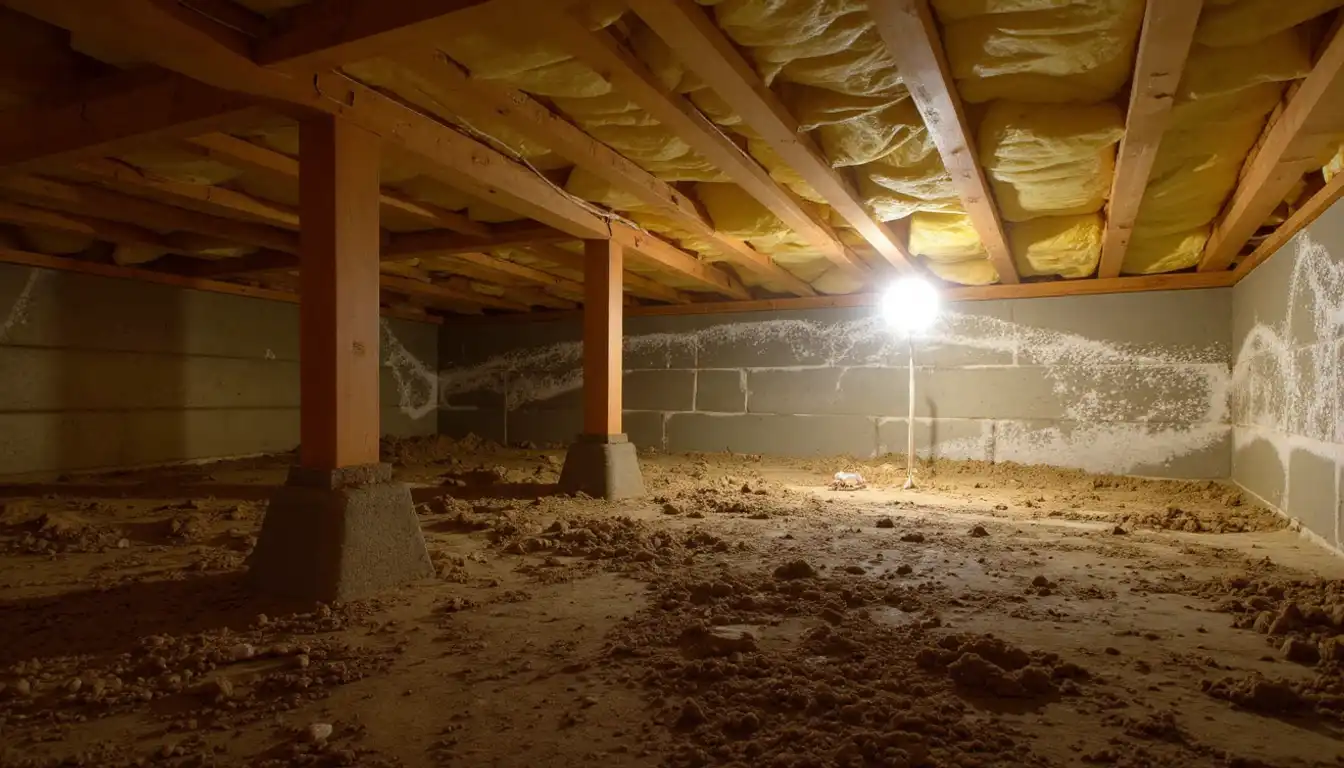
R-value degradation explains why homes insulated at construction still have cold floors decades later. Fiberglass batt insulation — the most common material installed between floor joists — relies on trapped air pockets for thermal resistance. Any condition that compresses, wets, or displaces those air pockets reduces performance dramatically.
Moisture is the primary cause of fiberglass failure in crawlspaces. In a crawlspace where relative humidity regularly exceeds 70%, fiberglass batts absorb ambient moisture and gain weight. A batt that weighed two pounds when installed can weigh five or six pounds after several years. That added weight causes sagging away from the subfloor, breaking contact with the surface it was meant to insulate.
Sagging insulation creates an air gap that eliminates most of its thermal value. When a fiberglass batt sags even one inch from the subfloor, convective air currents form in the gap. These currents carry heat away from the floor far more effectively than still air. The insulation effectively becomes a ceiling for the crawlspace rather than a thermal barrier for the floor. The rated R-value becomes meaningless once contact is broken.
Pest activity and gravity accelerate displacement. Rodents nest in fiberglass, pulling it apart and creating voids. Wire hangers and friction fit weaken over time. A crawlspace inspection frequently reveals sections where insulation has fallen to the ground entirely, leaving bare joist bays with zero thermal resistance.
Insulation Reality
Fiberglass batts in crawlspaces absorb moisture, sag from joists, and can lose the majority of their rated R-value within a few years — a gradual process homeowners rarely notice until cold floors become a conscious complaint
Interactive: Insulation R-Value Over Time
See how moisture and gravity erode your crawlspace insulation's performance year by year.
Crawlspace Insulation Degradation Over Time
What this shows: In a vented crawlspace, fiberglass insulation absorbs moisture, sags from the subfloor, and loses the majority of its thermal performance within 5-10 years.
Section 5 of 8
Regional Factors: Kansas City vs. Des Moines
Frost depth determines how cold the soil and foundation walls surrounding your crawlspace become — which directly influences your floor temperature above.
| Factor | Kansas City | Des Moines |
|---|---|---|
| Design frost depth | 36 inches | 42 inches |
| Heating degree days / year | ~5,000 | ~6,500 |
| Typical winter crawlspace temp (vented) | 35-45°F | 30-40°F |
| Freeze-thaw severity on foundation | Moderate | Higher — deeper frost penetration |
Des Moines crawlspaces run colder than Kansas City crawlspaces during comparable conditions. The six-inch frost depth difference means more foundation wall surface area contacts frozen soil, extracting more heat from the crawlspace. Deeper frost penetration also produces more severe freeze-thaw cycling at the soil-foundation interface, creating micro-gaps that admit cold exterior air at the base of the wall.
Section 6 of 8
Why Turning Up the Thermostat Doesn't Fix Cold Floors
Raising the thermostat increases air temperature at chest height without proportionally warming the floor below. Forced-air systems deliver warm air through supply registers, and that air rises toward the ceiling. Increasing from 70 to 74°F may raise the floor surface by only 1-2 degrees because the additional heat exits through the upper envelope before it can conduct downward.
The energy cost is substantial. The DOE estimates that proper crawlspace sealing reduces heating and cooling energy by 10-30%. When you raise the thermostat to compensate, you're spending that premium every month indefinitely. The energy leak calculator quantifies this ongoing cost.
Higher settings amplify the stack effect. A warmer interior creates a larger temperature differential, which increases upward pressure. More warm air exits from above, more cold crawlspace air is drawn upward. You're caught in a feedback loop: turning up the heat increases the driving force that pulls cold air in from below.
Comfort requires surface temperature, not just air temperature. Research defines thermal comfort as a combination of mean radiant temperature (surrounding surfaces) and air temperature. When the floor — the largest surface in the room — is 12 degrees colder than the air, no thermostat setting achieves true comfort. The floor surface temperature must increase, and that requires reducing heat loss through the floor assembly.
Section 7 of 8
Fix Sequence by Cause
The order matters — each step creates the conditions that make the next step effective.
| Priority | Intervention | What It Addresses | Expected Floor Temp Improvement |
|---|---|---|---|
| 1 | Air-seal rim joist and floor penetrations | Stops cold air infiltration — the dominant heat loss in leaky floor assemblies | 3-5°F improvement |
| 2 | Replace degraded insulation (spray foam or rigid foam) | Restores thermal resistance at the floor boundary | 3-5°F additional |
| 3 | Full encapsulation — vapor barrier, vent sealing, wall insulation | Moves thermal boundary to crawlspace walls; stabilizes crawlspace at 55-65°F year-round | 5-10°F total (includes above steps) |
| 4 | Dehumidification | Prevents future insulation degradation by controlling moisture | Preserves gains long-term |
DOE Research Finding
Proper crawlspace sealing and insulation can reduce heating and cooling energy consumption by 10-30%. Field measurements show floor surface temperature increases of 5-10°F after comprehensive crawlspace improvement.
The choice between floor-level treatment and full encapsulation depends on overall crawlspace condition. If moisture levels are controlled and the crawlspace is structurally sound, air sealing + insulation may be sufficient. If the crawlspace has elevated humidity, mold growth, or degraded structural members, encapsulation addresses both comfort and the environmental conditions causing insulation failure. The cost analysis compares these approaches.
Self-Assessment: Is Air Sealing Enough, or Do You Need Full Encapsulation?
Answer these questions about your crawlspace:
- Is relative humidity above 60%? (Use a $15 hygrometer for 48 hours)
- Do you see visible mold on joists or subfloor?
- Has insulation fallen to the ground in multiple areas?
- Do you notice musty smells on the first floor?
- Is there standing water or damp soil in the crawlspace?
If you answered "yes" to 2 or more: The crawlspace environment itself needs to change. Air sealing and insulation alone won't hold up — moisture will degrade new insulation the same way it degraded the old. Full encapsulation is the durable path. 0-1 "yes" answers: Air sealing + insulation replacement may be sufficient.
Section 8 of 8
What to Document Before Calling a Professional
Having this information ready makes your consultation more productive and helps you evaluate recommendations.
Documentation Checklist
- ☐ Floor temperature readings — Use an infrared thermometer in 3-4 rooms. Note the gap between floor surface and thermostat reading.
- ☐ Cold floor pattern — Uniform across first floor, concentrated near exterior walls, or specific rooms? Note which rooms are worst.
- ☐ Crawlspace access observation — Open the access door. Is insulation visibly sagging, fallen, or absent? Is the space noticeably colder than the house?
- ☐ Humidity reading — Place a hygrometer in the crawlspace for 24-48 hours. Note the reading.
- ☐ Energy bill trend — Compare this winter's heating costs to 2-3 years ago. Increasing bills alongside cold floors suggests progressive degradation.
- ☐ Other symptoms present — Musty smell? High energy bills? Soft spots in floors? These indicate the crawlspace environment needs comprehensive attention.
- ☐ Home age and crawlspace type — Vented or sealed? When was insulation last inspected or replaced?
Related Symptoms
Cold floors rarely occur in isolation. The same crawlspace conditions that cause cold floors typically produce these related problems:
- High Energy Bills — The same heat loss pathways that chill your floors waste 10-30% of your heating and cooling energy
- Musty Smell — Air infiltration from the crawlspace carries mold-produced volatile compounds into your living space
- Sagging Floors — The moisture that degrades insulation also weakens structural wood over time
- Complete Crawlspace Guide — Comprehensive overview of crawlspace conditions, improvement methods, and decision framework
Frequently Asked Questions About Cold Floors and Crawlspaces
Cold floors with the heat running indicate that your crawlspace is pulling warmth out of the floor assembly faster than your HVAC system can replace it. The stack effect draws unconditioned crawlspace air upward through gaps in the subfloor, and conductive heat transfer through uninsulated floor joists creates a subfloor temperature gradient that keeps the floor surface well below room air temperature. Raising the thermostat compensates temporarily but does not address the underlying heat loss pathway.
Partial improvements are possible without full encapsulation. Air-sealing the rim joist area and floor penetrations reduces infiltration, and replacing degraded fiberglass batts with rigid foam or spray foam restores thermal resistance at the floor level. However, these floor-level interventions leave the crawlspace environment uncontrolled, meaning moisture and temperature extremes continue to stress insulation performance over time. Full encapsulation addresses the root environment and delivers the most durable results.
Insulating the crawlspace dirt floor with a vapor barrier reduces ground moisture evaporation but does not directly warm your floors above. The insulation that matters for floor surface temperature is located in the floor assembly between your living space and the crawlspace — specifically the subfloor cavity between joists and the rim joist perimeter. In sealed crawlspace designs, insulation moves to the foundation walls instead, bringing the entire crawlspace inside the thermal boundary.
Cold floors often accompany other crawlspace-related symptoms including high humidity, musty odors, and uneven room temperatures. The same air leakage pathways that allow heat to escape also permit moisture and crawlspace air to enter your living space. If your floors are noticeably cold, it is reasonable to investigate the crawlspace for sagging insulation, open penetrations, and elevated moisture levels that may be affecting both comfort and structural durability.
Field measurements in homes that have undergone crawlspace sealing and insulation upgrades typically show floor surface temperature increases of 5 to 10 degrees Fahrenheit during winter months. The exact improvement depends on the starting condition — homes with no insulation or severely degraded batts see the largest gains. Homeowners consistently report that the floor temperature difference is one of the first and most noticeable changes after crawlspace work is completed.
Uneven floor temperatures across the first floor typically result from inconsistent insulation coverage in the crawlspace below. Areas where fiberglass batts have fallen, compressed, or absorbed moisture lose thermal resistance and produce noticeably colder floor zones above them. Rooms located above crawlspace sections with more air leakage — near rim joists, plumbing penetrations, or HVAC chases — also tend to run colder because infiltration rates vary across the floor assembly.