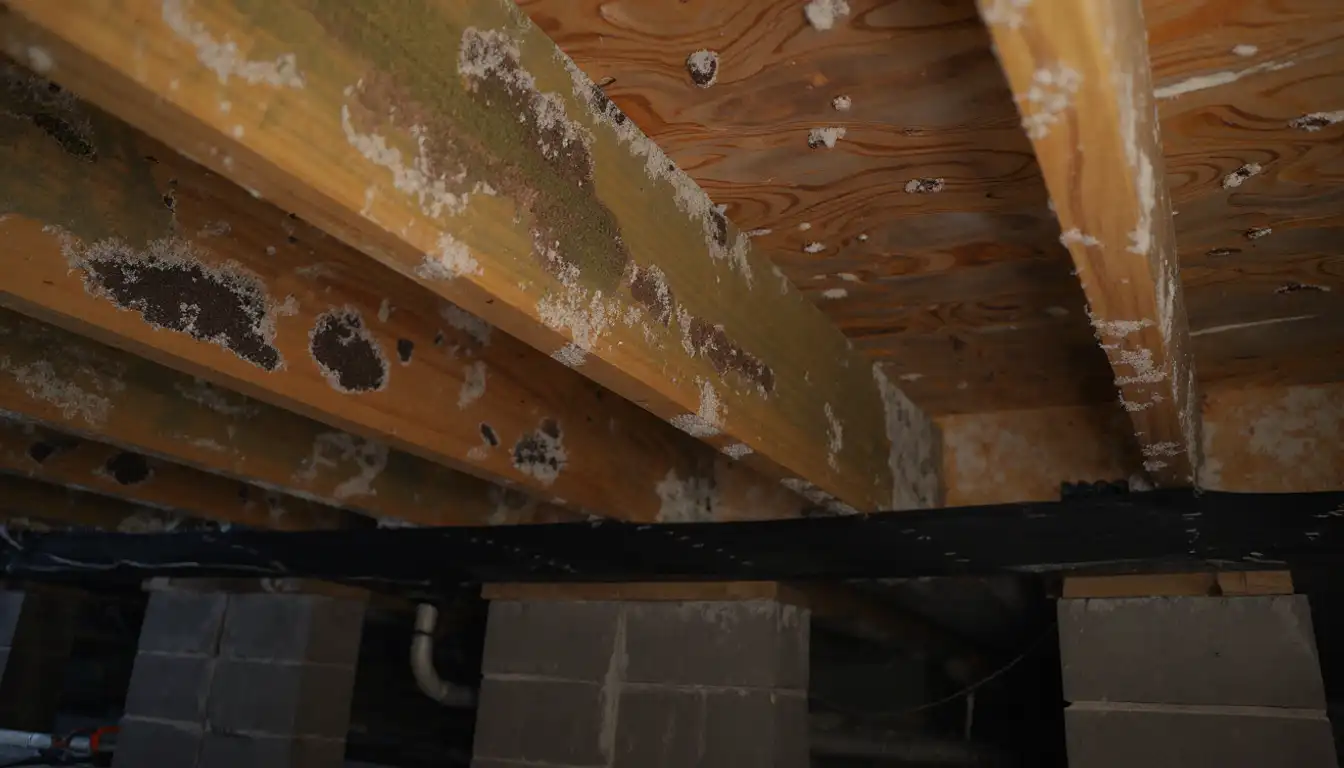
Section 1 of 8
Severity Assessment: How Bad Is Your Mold Problem?
Use these indicators to assess where your situation falls. Severity determines whether you need monitoring, targeted intervention, or professional remediation.
| Stage | What You See / Measure | What It Means | Recommended Action |
|---|---|---|---|
| Early | Musty smell on first floor; crawlspace RH 60-70%; no visible growth | Conditions support mold — colonization likely starting at microscopic level | Measure humidity; plan moisture control before growth becomes visible |
| Moderate | Scattered mold patches on joists/subfloor; RH 70-80%; musty smell persistent | Active colonies established; spore production underway | Professional assessment; moisture control + targeted remediation |
| Advanced | Extensive growth across multiple surfaces; dark staining on wood; RH 80%+ | Widespread colonization; structural wood at risk; high spore counts in living space | Professional remediation before encapsulation; assess wood damage |
| Severe | Thick growth + soft/spongy wood; household health symptoms; visible mold in living space | Structural damage + health impact; mold has spread beyond crawlspace | Urgent — professional remediation + structural assessment + encapsulation |
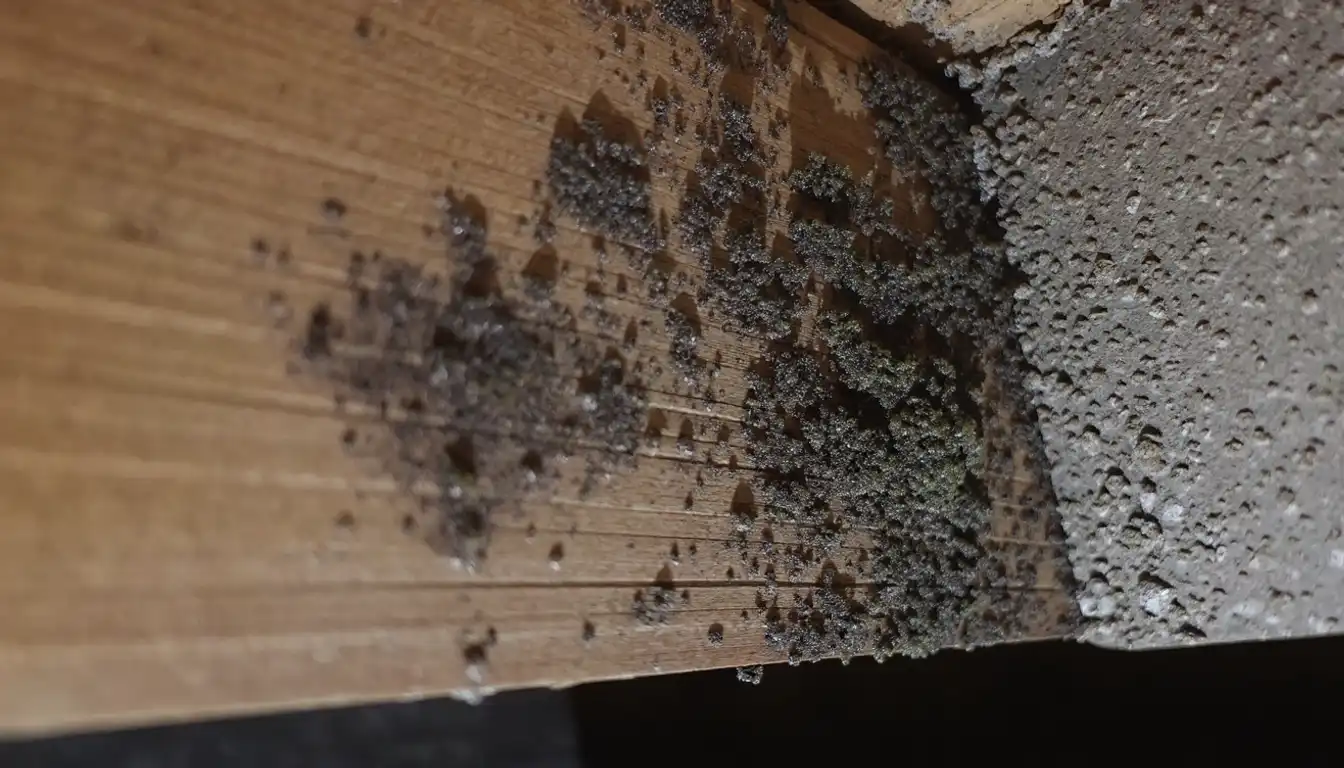
Mold colonization at the sill plate junction where wood meets concrete — this is typically the first location where mold establishes because moisture concentrates at this boundary.
Self-Assessment: Quick Mold Risk Check (No Crawlspace Entry Required)
You can assess risk from inside your home:
- Musty smell on first floor? Especially one that intensifies in warm, humid weather — strong signal of active mold below
- Allergy symptoms that improve away from home? Sneezing, congestion, itchy eyes that clear up on vacation or at the office
- Smell intensifies when HVAC cycles on? Suggests ductwork in crawlspace is delivering contaminated air
- Crawlspace access door test: Open it and compare smell intensity to living space. Dramatically stronger = active source below
For definitive data, place a hygrometer ($15) in the crawlspace for 48 hours. Above 60% = mold-favorable conditions. Our Mold Risk Score tool uses these thresholds to evaluate your situation.
Section 2 of 8
Common Crawlspace Mold Species
The crawlspace environment selects for a specific group of fungal species. Each has distinct growth preferences, appearance, and health implications.
| Species | Appearance | Growth Conditions | Health Concern |
|---|---|---|---|
| Aspergillus | Green, yellow, white, or brown | Most common genus; thrives on cellulose in joists and subflooring; prolific spore producer | Allergic reactions; aspergillosis risk for immunocompromised individuals |
| Penicillium | Blue-green | Fast colonizer; can grow at slightly lower humidity (55-60%); common on insulation and wood | Primary source of musty MVOCs; respiratory allergen |
| Stachybotrys | Dark greenish-black; slimy texture | Requires sustained saturation (not just humidity); less common than above | Mycotoxin producer — more severe respiratory and neurological effects possible |
| Cladosporium | Olive-green to brown/black | Common indoors and outdoors; elevated humidity sufficient; grows on wood and insulation | Significant allergen; common asthma trigger |
Common Misconception
"Bleach kills mold permanently."
Reality: Bleach kills surface mold on non-porous materials, but on porous wood — the primary colonization site in crawlspaces — it cannot reach the root structures (hyphae) embedded in the grain. Within weeks, mold returns because moisture conditions remain unchanged. Effective mold management requires reducing humidity below 60% so new growth cannot establish. Remediation treats the existing problem; moisture control prevents recurrence.
Section 3 of 8
The 60% Relative Humidity Threshold
At 60% RH and above, moisture content of organic materials rises to a level that supports fungal spore germination. Below 60%, most species enter dormancy. This threshold is one of the most well-established findings in building science.
In Kansas City and Des Moines, summer outdoor RH routinely reaches 75-85%. Vented crawlspaces import this air directly. Field research measured 77% average RH in vented crawlspaces vs. 52% in sealed crawlspaces — placing vented designs firmly above the mold threshold from May through September.
Ground vapor amplifies the problem. Exposed soil releases 10-15 gallons of water vapor per day from a 1,000 sq ft footprint. This moisture raises crawlspace humidity and is absorbed into every organic surface. Understanding the physics behind crawlspace moisture explains why this single measurement controls so much.
Wood moisture content provides an even more direct assessment. When wood absorbs moisture from humid air, its internal moisture content rises. At 19-20% wood MC, mold colonization accelerates. A pin-type moisture meter ($25-50) gives you a precise reading. Our Mold Risk Score tool uses these thresholds.
Section 4 of 8
How Quickly Mold Colonizes Once Conditions Are Right
| Timeline | What's Happening | Visible? |
|---|---|---|
| 24-48 hours | Spore germination — dormant spores activate and begin extending hyphae into wood | No — microscopic only |
| 3-12 days | Hyphae penetrate wood surface; cellulose breakdown begins | No — inspection shows nothing unusual |
| 1-3 weeks | Visible colony formation; active spore production begins (millions daily per colony) | Yes — visible growth on joists and subfloor |
| 1+ months | Colony expansion; adjacent surfaces seeded; crawlspace-wide spread accelerating | Yes — multiple surfaces colonized |
This speed explains why seasonal approaches fail. Closing vents only in winter or running a dehumidifier only when you notice a smell allows repeated colonization cycles — each adding new growth on top of existing colonies. Prevention requires maintaining conditions below threshold continuously, not periodically.
Section 5 of 8
Health Effects of Crawlspace Mold Exposure
Effects vary by species, concentration, duration, and individual sensitivity. You don't need to enter the crawlspace to be affected — the stack effect delivers spores to every room.
| Symptom Category | Common Effects | Who's Most Affected |
|---|---|---|
| Respiratory | Coughing, throat irritation, nasal congestion that persists indoors | Everyone; more severe for asthma sufferers |
| Allergic | Sneezing, runny nose, itchy/watery eyes, skin irritation | Allergy-sensitive individuals; children; elderly |
| Asthma | Increased attack frequency and severity (WHO and IOM documented) | Existing asthma patients — mold is a controllable trigger |
| General | Headaches, fatigue, difficulty concentrating | Sustained exposure; intensifies on humid days or when HVAC cycles |
| Mycotoxin | Inflammatory respiratory response; neurological symptoms in prolonged cases | Exposure to Stachybotrys or certain Aspergillus species |
The distinguishing pattern: Symptoms occur or worsen while inside the home, improve when away for extended periods, and often intensify on humid days or when the HVAC system cycles on — pulling crawlspace air through the duct system.
Section 6 of 8
How Mold Spores Travel from Crawlspace to Living Space
The stack effect operates continuously. Warm air rises and exits through the upper envelope; replacement air is drawn upward from the crawlspace through every gap in the floor system. 40-50% of first-floor air originated below — carrying spores, MVOCs, and mycotoxins.
HVAC ductwork creates a direct delivery route. Ducts in the crawlspace with leaking joints inject crawlspace air into your HVAC system when the blower engages, distributing contaminated air to every room. This is often a more concentrated pathway than passive stack-effect infiltration.
The intensity increases in winter (when temperature differential drives the stack effect hardest) but never stops entirely. This is why the musty odor associated with crawlspace mold can be detected on any floor, not just at ground level.
Section 7 of 8
Fix Sequence: Remediation vs. Prevention
Remediation treats existing mold. Prevention changes conditions so new mold cannot grow. You need both, in the correct sequence. Confusing them is one of the most costly mistakes homeowners make.
| Step | Action | What It Accomplishes | Without This Step |
|---|---|---|---|
| 1 | Professional mold remediation (if moderate-to-severe growth) | Removes existing colonies and MVOC reservoir from wood surfaces | Encapsulating over active mold traps colonies beneath barrier |
| 2 | Encapsulation — vapor barrier over soil + sealed vents | Eliminates ground vapor (10-15 gal/day) and summer humidity influx | Humidity climbs back above 60% within days; new spores germinate |
| 3 | Dehumidification — maintain 45-55% RH | Controls residual moisture from concrete walls and seasonal fluctuation | Edge cases may still exceed threshold during peak humidity months |
Critical Sequence
Remediate first, then seal. If active colonies are present, they should be professionally treated before encapsulation. Encapsulating over active mold traps existing colonies beneath the barrier, where they may continue producing spores and mycotoxins. Remediation first, then environmental control — this separates a lasting solution from a temporary one.
When the crawlspace is sealed and dehumidified at 45-55% RH, spores may land on surfaces — they're always present in air — but they cannot germinate, extend hyphae, or form colonies. The biological trigger is never pulled. For cost information, see our cost and methods comparison.
Section 8 of 8
What to Document Before Calling a Professional
Documentation Checklist
- ☐ Visible growth description — Color, texture, location (which surfaces?), approximate area covered. Photos if possible.
- ☐ Humidity reading — Place a hygrometer in crawlspace for 48 hours. Record the number.
- ☐ Wood condition — Can you press a screwdriver into any joists or sill plates easily? (Indicates decay alongside mold)
- ☐ Smell pattern — Where is musty smell strongest? First floor vs. upstairs? Near registers? Seasonal pattern?
- ☐ Health symptoms — Any household members with respiratory issues, allergies, or headaches that improve away from home?
- ☐ Crawlspace configuration — Vented or sealed? Vapor barrier present? Standing water?
- ☐ Other symptoms — Soft/bouncy floors? Pest evidence? These indicate moisture has been elevated long enough to cause additional damage.
- ☐ Timeline — When did you first notice the smell or symptoms? Getting worse over time?
Related Symptoms
Crawlspace mold is driven by the same moisture conditions that produce these related problems:
- Musty Smell — The MVOCs that mold produces are what you're smelling on your first floor
- Sagging Floors — The same humidity that sustains mold also feeds decay fungi that weaken structural wood
- Pest Intrusion — Moisture-softened wood attracts termites and carpenter ants alongside mold
- High Energy Bills — Crawlspace humidity overloads your AC with latent cooling demand
- Complete Crawlspace Guide — Full decision framework for assessing and improving crawlspace conditions
Frequently Asked Questions About Crawlspace Mold
Stachybotrys chartarum — commonly called black mold — produces mycotoxins that can cause respiratory irritation, headaches, and more severe reactions in sensitive individuals. However, color alone does not identify a mold species. Several harmless molds appear dark or black, while some harmful species appear green or white. Air sampling or surface testing by a qualified assessor is the only reliable way to identify what is growing in your crawlspace and whether it poses a health concern.
Yes. The stack effect — the natural upward movement of air through your home — continuously draws air from the crawlspace into your living space. Research indicates that 40 to 50 percent of the air on your first floor originated beneath your home. Mold spores, mycotoxins, and volatile organic compounds produced by mold growth travel upward through gaps around plumbing penetrations, ductwork, and the rim joist, reaching every room regardless of whether anyone physically enters the crawlspace.
Several indicators suggest mold activity below your home without requiring a crawlspace visit. A persistent musty or earthy smell on the first floor — especially one that intensifies in warm, humid weather — is a strong signal. Increased allergy symptoms among household members that improve when away from home can also point to airborne mold spore exposure. For a definitive answer, an indoor air quality test comparing spore counts inside your home to outdoor baseline levels can confirm whether mold from the crawlspace is affecting your living environment.
Bleach can kill surface mold on non-porous materials, but it does not address the underlying humidity that caused the growth. On porous surfaces like wood joists and subflooring — the primary colonization sites in crawlspaces — bleach kills surface growth but cannot reach the root structures (hyphae) embedded in the wood grain. Within weeks, mold typically returns because the moisture conditions that supported the original colony remain unchanged. Effective mold management requires reducing crawlspace relative humidity below 60 percent so that new growth cannot establish.
Research consistently identifies 60 percent relative humidity as the threshold below which most mold species cannot germinate or sustain active growth. The ideal target range for a crawlspace is 45 to 55 percent relative humidity. Field studies by Advanced Energy found that sealed crawlspaces maintained an average of 52 percent relative humidity, while vented crawlspaces averaged 77 percent — well above the mold growth threshold for most of the year.
Sealing the crawlspace with a vapor barrier and closing foundation vents addresses the two primary moisture sources — ground evaporation and humid outdoor air infiltration — that sustain mold growth. When combined with mechanical dehumidification to maintain humidity below 60 percent, sealed crawlspaces create conditions where mold cannot germinate or colonize new surfaces. Existing mold on wood surfaces should be professionally remediated before sealing, since encapsulation alone does not eliminate colonies that have already established.