Section 1 of 7
Diagnose: Which Energy Loss Pathway Is Hitting You Hardest?
Match your symptoms to the most likely crawlspace energy loss mechanism. Most homes have multiple pathways active simultaneously.
| What You Experience | Primary Loss Pathway | Estimated Energy Impact |
|---|---|---|
| Bills 10-20% higher than neighbors with similar homes | Multiple pathways — insulation degradation + air infiltration | 10-15% excess |
| Bills 20-30%+ higher; HVAC runs constantly | Duct leakage in crawlspace + air infiltration + thermal bypass | 20-30% excess |
| Summer AC bills spike; house feels humid despite running AC | Humidity load from crawlspace — latent cooling consuming AC capacity | 20-30% of cooling capacity wasted on moisture |
| Rooms farthest from HVAC are coldest/hottest | Supply duct conductive loss — air loses 10-15°F traveling through cold crawlspace | Significant comfort + energy penalty |
| Bills rising year over year (same usage patterns) | Progressive insulation degradation — fiberglass losing R-value annually | Compounding — increases each year |
| Cold floors in winter + high heating bills | Floor-level thermal bypass — heat draining through subfloor assembly | 10-15% heating penalty |
Key Data Point
DOE research: sealed crawlspaces reduce heating and cooling energy use by 10-30% compared to vented designs. The Energy Leak Calculator estimates where your home falls within that range.
Common Misconception
"A new, higher-efficiency furnace will fix my high energy bills."
Reality: If your ductwork leaks 300+ CFM of conditioned air into the crawlspace, a higher-efficiency furnace simply loses expensive air more efficiently. A 96% AFUE furnace with leaky ducts delivers less comfort than an 80% furnace with sealed ducts. Addressing the building envelope — duct sealing, air sealing, insulation — almost always delivers more savings per dollar than equipment upgrades.
Section 2 of 7
Duct Leakage: The Biggest Single Energy Loss
The Advanced Energy 100-home field study measured average crawlspace duct leakage exceeding 300 CFM. A typical residential HVAC system moves 1,000-1,400 CFM total. Losing 300 CFM means roughly 20-30% of your heated or cooled air never reaches a supply register.
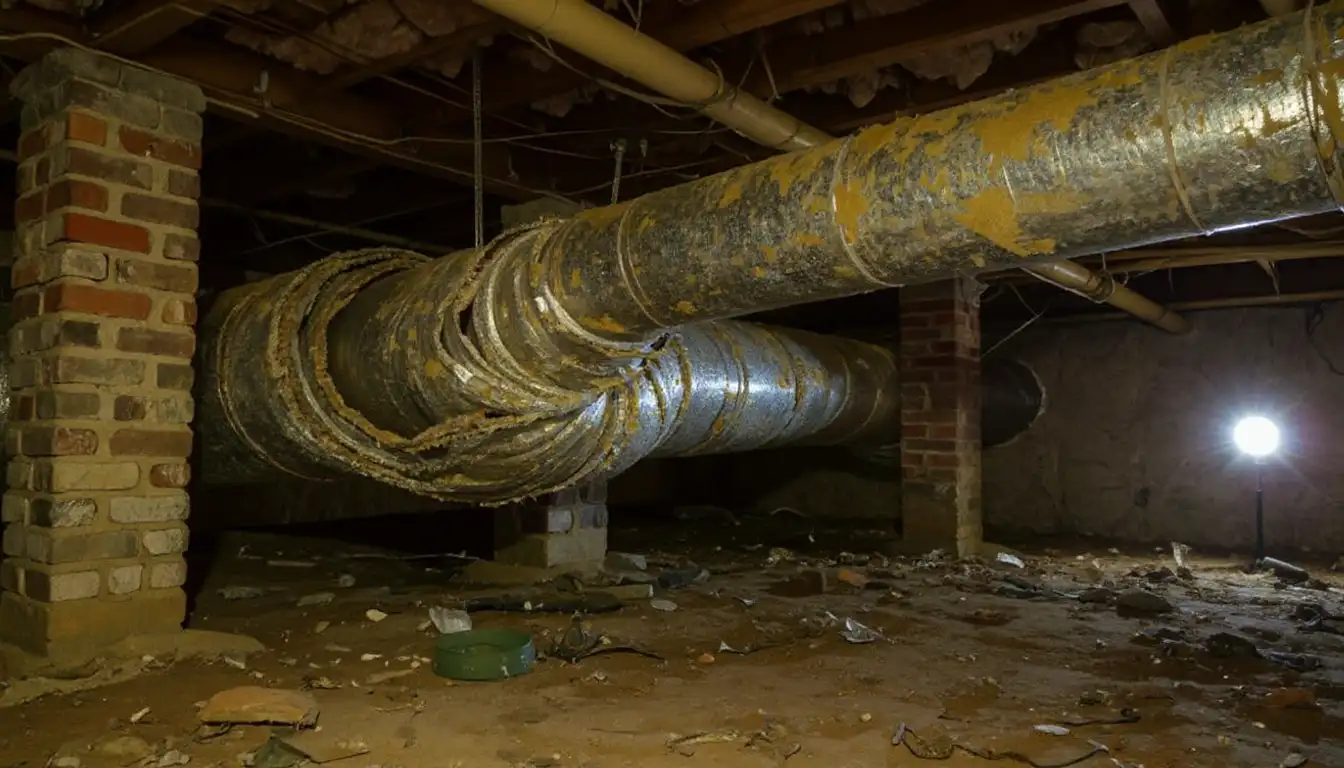
Supply duct leakage = direct thermal loss. When heated air at 120°F escapes from a duct joint into a 40°F crawlspace in January, that energy is entirely wasted. The crawlspace doesn't need heating, and in a vented configuration, the leaked air exits through foundation vents within minutes.
Return duct leaks contaminate the air your system processes. Return ducts under negative pressure pull crawlspace air — 40°F in winter, 90°F and moisture-laden in summer — directly into the air handler. The system works harder, runs longer, and delivers inconsistent comfort because its air supply is contaminated at the source.
Advanced Energy Study Finding
Average crawlspace duct leakage: 300+ CFM — equivalent to losing 20-30% of conditioned airflow. A duct blaster test quantifies your home's specific leakage.
Even ducts with no leaks lose energy through conduction. A supply duct carrying 120°F air through a 40°F crawlspace loses heat through the duct wall continuously. Standard R-6 flex duct insulation reduces but doesn't eliminate this. Over a 20-40 foot run, delivered air temperature can drop 10-15°F before reaching the register — which is why rooms farthest from the air handler feel coldest in winter and warmest in summer.
Section 3 of 7
Humidity Load: The Invisible AC Drain
Your air conditioner performs two jobs simultaneously: removing heat (sensible cooling) and removing moisture (latent cooling). Both consume energy and compete for the same cooling capacity. When crawlspace humidity increases moisture in your indoor air, the latent load grows and steals capacity from temperature reduction.
The stack effect delivers this humidity directly. In a home with a vented crawlspace averaging 77% RH, 40-50% of first-floor air arrives loaded with moisture from below. Your AC must remove that moisture before it can cool effectively — increasing both runtime and energy consumption.
HVAC overcycling from humidity load is one of the most misdiagnosed energy problems. High latent load causes the AC to run longer for dehumidification, which can overcool the space and trigger short cycling. Each start-stop cycle wastes energy on compressor startup and reduces effective seasonal efficiency. A 16-SEER unit operating with elevated latent load may deliver effective performance closer to 12-13 SEER.
| Crawlspace Type | Average Humidity | AC Latent Load Impact |
|---|---|---|
| Vented crawlspace | 77% RH average | 20-30% of cooling capacity consumed by moisture removal |
| Sealed crawlspace | 52% RH average | Minimal latent load — AC spends capacity on temperature |
Sealed crawlspaces dramatically reduce this problem. That 25-percentage-point humidity difference translates directly to your AC spending more capacity on temperature reduction and less on dehumidification. Related thermal effects are covered on our cold floors page.
Section 4 of 7
Why Your HVAC Runs Constantly Without Making the House Comfortable
An HVAC system that runs continuously without reaching setpoint is working against losses it cannot overcome. The system generates adequate capacity at the air handler, but by the time conditioned air travels through leaky ducts in an extreme-temperature crawlspace, passes through registers into rooms receiving unconditioned air from below, and returns through leaky return ducts mixed with crawlspace air — net delivered comfort is a fraction of rated capacity.
The diagnostic question is not whether your HVAC is powerful enough, but whether your building envelope retains the energy it produces. On a January night in Kansas City when outdoor temps hit the teens, cold air entering through floor-level gaps can exceed your heating system's output capacity. A blower door test quantifies total envelope leakage; a duct blaster test isolates duct leakage specifically.
In most cases, reducing envelope losses delivers more comfort improvement than upgrading to a larger or more efficient HVAC unit. This is the fundamental insight that separates effective energy improvement from expensive equipment replacement that doesn't solve the problem.
Self-Assessment: Is Your HVAC the Problem or the Victim?
Answer these questions to determine whether your high bills come from equipment or envelope:
- Does your system run for long stretches without reaching the thermostat setpoint? (Envelope problem)
- Are rooms farthest from the air handler noticeably less comfortable? (Duct loss in crawlspace)
- Do bills spike in the most extreme weather months? (Losses proportional to temp differential)
- Does the house feel humid despite AC running? (Crawlspace humidity load on cooling system)
- Is your ductwork located in the crawlspace? (Highest-risk configuration for energy loss)
3 or more "yes" answers: Your HVAC is likely the victim, not the problem. The crawlspace envelope is where your energy is going. Envelope improvements (duct sealing, air sealing, encapsulation) will deliver more savings than equipment upgrades.
Section 5 of 7
Seasonal Patterns: Kansas City and Des Moines
Both markets experience the full spectrum of crawlspace energy challenges — hot, humid summers plus cold, dry winters means energy losses compound year-round through different mechanisms.
| Season | Dominant Loss Mechanism | KC Impact | Des Moines Impact |
|---|---|---|---|
| Summer | Humidity loading, duct condensation, AC overcycling | 75-85% outdoor RH; severe latent load | 75-85% outdoor RH; comparable |
| Winter | Air infiltration, duct conductive loss, floor-level heat drain | ~5,000 heating degree days | ~6,500 HDD — 30% more heating demand |
| Spring/Fall | Transition stress — wide day/night swings stress duct connections | Moderate | Moderate-high |
A home losing 15% of heating energy during 5,000-6,500 heating degree days and 15% of cooling energy through humidity loading during 1,000-1,200 cooling degree days experiences cumulative annual losses that significantly exceed what either season alone would suggest. This is why comprehensive crawlspace improvement — not seasonal band-aids — produces meaningful reduction in annual energy consumption.
Interactive: Energy Loss Estimator
Estimate how much energy your crawlspace condition may be costing you each year.
Section 6 of 7
Fix Sequence by Energy Recovery
Prioritized by energy recovery per dollar. The order matters — sealing air leaks before adding insulation, and controlling moisture before sealing the space.
| Priority | Intervention | Primary Energy Mechanism | Estimated Recovery |
|---|---|---|---|
| 1 | Seal duct leakage | Recovers 20-30% of lost conditioned airflow | Highest single-intervention ROI |
| 2 | Air-seal floor assembly (rim joist, penetrations, boot connections) | Stops stack-effect infiltration; EPA estimates 15% energy savings | High — reduces infiltration-driven losses |
| 3 | Insulation upgrade (spray foam or rigid board) | Reduces conductive heat transfer through floor or walls | 15% heating/cooling reduction (EPA) |
| 4 | Full encapsulation — vapor barrier, vent sealing, wall insulation | Addresses all pathways simultaneously; converts duct leakage from loss to neutral | 10-30% total (DOE baseline) |
| 5 | Dehumidification | Eliminates humidity load on AC; prevents future insulation degradation | Preserves gains; reduces AC latent load |
The right combination depends on your specific conditions. A home with well-sealed ducts but no vapor barrier has different priorities than one with new ductwork but open vents. The Energy Leak Calculator helps prioritize, and our cost analysis page covers investment and return data for each type.
Section 7 of 7
What to Document Before Calling a Professional
Documentation Checklist
- ☐ Recent energy bills — Gather 12 months of statements. Note seasonal peaks and year-over-year trends.
- ☐ HVAC system details — Age, type (furnace/heat pump), efficiency rating. Where is the air handler? Where does ductwork run?
- ☐ Ductwork location — In the crawlspace, attic, or interior? Visible disconnections, sagging, or damage?
- ☐ Crawlspace configuration — Vented or sealed? Vapor barrier present? Foundation vent condition (open, screened, sealed)?
- ☐ Comfort complaints — Which rooms are hardest to heat/cool? Does the system run long cycles without reaching setpoint?
- ☐ Humidity observations — Does the house feel humid despite AC running? Condensation on windows? Place a hygrometer in the crawlspace for 48 hours.
- ☐ Other symptoms — Cold floors? Musty smell? These confirm crawlspace is contributing to energy waste.
- ☐ Prior improvements — Any past weatherization, insulation, or HVAC work? Did bills change after?
Related Symptoms
High energy bills caused by crawlspace conditions almost always appear alongside these related problems:
- Cold Floors — The same thermal bypass that wastes energy makes your floor surfaces 10-15°F colder than the thermostat
- Musty Smell — Crawlspace humidity that overloads your AC also sustains mold that produces indoor odors
- Crawlspace Mold — The 77% average humidity in vented crawlspaces is well above the 60% mold threshold
- Complete Crawlspace Guide — Full decision framework covering all improvement methods and their energy impact
Frequently Asked Questions About Crawlspace Energy Loss
Department of Energy research indicates that unsealed crawlspaces contribute to 10-30% of total heating and cooling energy waste. The exact percentage depends on duct leakage volume, insulation condition, air sealing quality, and whether the crawlspace is vented or sealed. Homes with HVAC ductwork in a vented crawlspace typically fall toward the higher end of that range.
A new furnace improves the efficiency of heat generation, but it does not address where that heat goes after it leaves the unit. If your ductwork leaks 300+ CFM of conditioned air into an unsealed crawlspace, a higher-efficiency furnace simply loses expensive air more efficiently. Addressing duct leakage and crawlspace air sealing first ensures that your existing system — or a new one — delivers conditioned air where it belongs.
Your air conditioner removes both heat (sensible load) and moisture (latent load) from indoor air. When the stack effect pulls humid crawlspace air into your living space, the AC must remove that additional moisture before it can effectively lower the temperature. In homes with vented crawlspaces at 77% relative humidity, the latent load can consume 20-30% of total cooling capacity, leaving less capacity for actual temperature reduction.
Yes. Our Energy Leak Calculator uses your home's square footage, crawlspace type, duct location, insulation condition, and local climate data to estimate annual energy waste from crawlspace-related losses. The tool applies DOE and EPA research data to your specific inputs and provides a percentage-based estimate of recoverable energy. Visit the calculator at /tools/energy-leak-calculator/ to run your assessment.
The single most impactful improvement is sealing duct leakage in crawlspace HVAC systems, which alone can recover 15-25% of wasted conditioned air. Full crawlspace encapsulation — combining vapor barrier, wall insulation, air sealing, and vent closure — addresses all energy loss pathways simultaneously and typically delivers the DOE's projected 10-30% reduction in heating and cooling energy use.
The EPA estimates that proper insulation in crawlspaces and other under-insulated areas reduces heating and cooling energy use by an average of 15%. However, insulation alone is most effective when combined with air sealing. Fiberglass batts installed between floor joists without air sealing allow convective airflow to bypass the insulation, significantly reducing its real-world performance compared to its laboratory R-value rating.