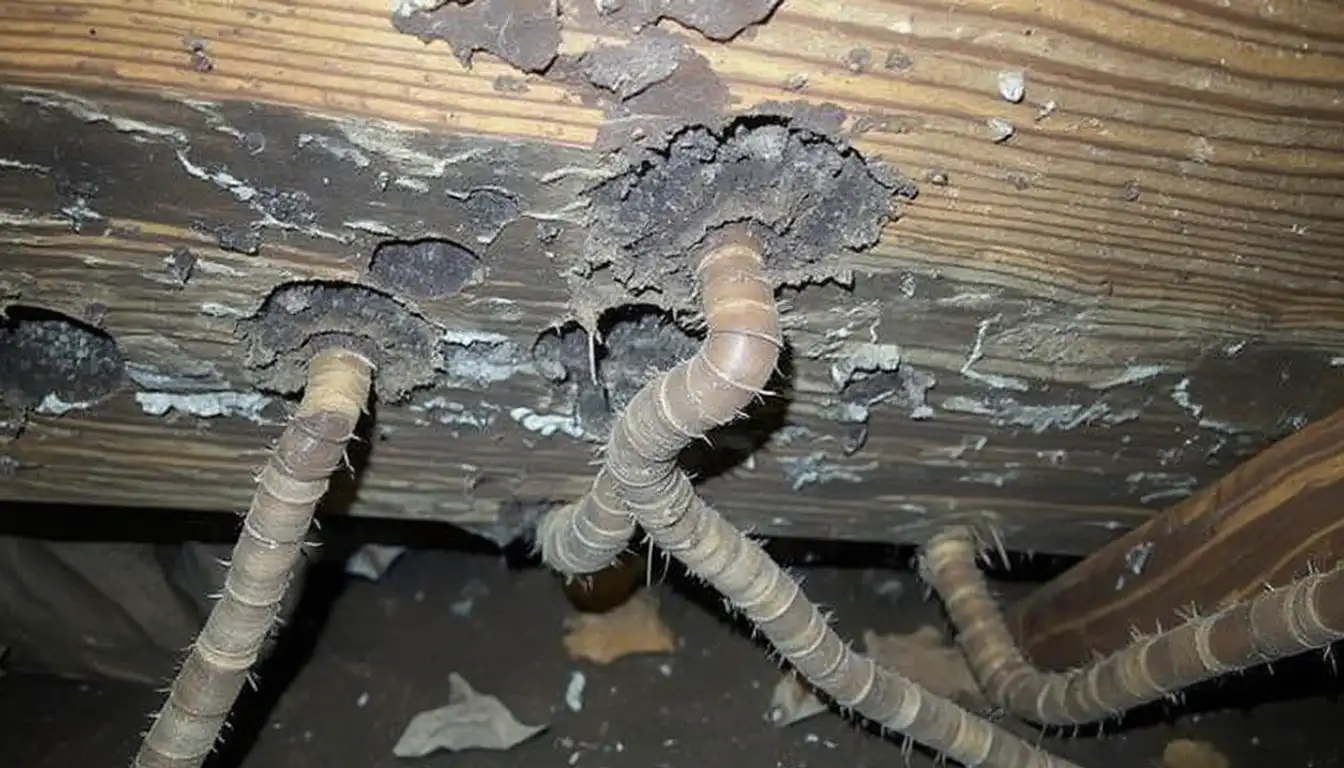
Section 1 of 8
Identify: What Pests Are in Your Crawlspace?
Use this table to identify which pest you're dealing with based on the evidence you can see.
| Evidence | Pest | What It Means |
|---|---|---|
| Mud tubes on foundation walls or piers | Subterranean termites | Active colony in soil; foraging on structural wood. Urgent — structural damage in progress. |
| Fine sawdust piles (frass) beneath joists | Carpenter ants | Excavating galleries in moisture-softened wood. Wood already weakened by moisture. |
| Smooth, clean tunnels inside wood (visible at breaks) | Carpenter ants | Established nesting galleries — different from rough termite damage. |
| Rough, layered damage inside wood; soil/fecal material in tunnels | Termites | Active feeding — wood being consumed as food source. |
| Droppings along sill plates; gnaw marks on insulation/wiring | Rodents (mice or rats) | Active nesting. Fire risk from gnawed wiring. Air quality affected. |
| Shredded insulation; grease marks on foundation walls | Rodents | Established travel paths and nesting. Insulation R-value destroyed. |
| Scratching/scurrying sounds at night from below floors | Rodents | Nocturnal activity in crawlspace; may have access to wall cavities. |
| Mosquitoes, drain flies, springtails, earwigs near floor level | Moisture insects | Standing water or extreme humidity in crawlspace. See also mold conditions. |
Self-Assessment: Quick Pest Risk Check
Check which apply to your crawlspace:
- Foundation vents with damaged or missing screens
- Exposed soil (no vapor barrier)
- Wood members in direct contact with soil
- Standing water or visibly damp surfaces
- Humidity above 70% (measured with hygrometer)
- Wood debris, cardboard, or stored materials in crawlspace
3 or more checked: Your crawlspace is providing ideal pest harborage. Even if no pests are visible now, conditions strongly favor colonization. 1-2 checked: Moderate risk — address these conditions proactively. 0 checked: Low risk, but periodic inspection remains good practice.
Section 2 of 8
What Pests Tell You About Your Moisture Problem
Different pest types indicate different severity levels of the underlying moisture condition. Pests are diagnostic — their presence tells you something specific about the crawlspace environment.
| Pest Present | What It Indicates | Moisture Severity |
|---|---|---|
| Moisture insects (springtails, earwigs, silverfish) | Consistently damp conditions; possible standing water | Moderate — humidity well above 60% |
| Carpenter ants | Wood is moisture-softened enough to excavate — already weakened structurally | Moderate-high — wood MC likely above 25% |
| Subterranean termites | Sustained moisture source + favorable wood conditions for feeding | High — long-term moisture exposure; structural damage probable |
| Rodents | Entry points exist + humid environment provides water source | Variable — primarily an access/exclusion issue, but moisture enables year-round habitation |
| Multiple pest types simultaneously | Crawlspace providing ideal harborage across species — all habitat requirements met | Severe — comprehensive moisture and exclusion intervention needed |
Section 3 of 8
Termites: The Moisture-Dependent Destroyer
Subterranean termites have a direct, measurable dependency on moisture. They live in soil and must maintain moisture contact at all times — building enclosed mud tubes to travel between soil and wood. A moist crawlspace provides an optimal foraging environment: damp soil directly below the foundation, short distances between soil and structural wood, and humidity that softens wood to make feeding more efficient.
Humidity above 70% makes termites more aggressive. At these levels (common in vented crawlspaces during warm months), wood moisture content rises above 25-30%, making it significantly easier for termites to consume. The moisture map of a crawlspace is often a reliable predictor of where termite activity will concentrate.
When crawlspace humidity drops below 50-55% and wood MC falls below 15%, the environment becomes hostile to termites. Mud tubes dry out and crack. Foraging workers lose their moisture bridge. The wood hardens to a state far more resistant to consumption. This is why moisture control is a foundational component of integrated pest management.
Section 4 of 8
Carpenter Ants: The Moisture Indicator
Carpenter ants don't eat wood — they excavate it for nesting. They specifically target moisture-softened wood because it's easier to excavate. Their presence in a crawlspace is a reliable indicator of a pre-existing moisture problem and wood that has already lost structural integrity.
The key identification sign is frass — cone-shaped piles of fine wood shavings beneath joist areas where ants are nesting. Frass is clean and dry, unlike termite damage residue which includes soil particles. Carpenter ant galleries inside wood are smooth-walled and follow the grain, distinctly different from rough termite tunnels.
Structural damage compounds over time. Carpenter ants nest in wood that moisture has already begun to weaken. Their excavation accelerates the loss of structural integrity — hollowing out the interior of joists that are already compromised by fungal decay. A joist with both moisture damage and carpenter ant galleries loses load-bearing capacity much faster than decay alone. This is one reason sagging floors sometimes indicate both conditions simultaneously.
Section 5 of 8
Rodents: Entry Points and Damage
Rodents exploit the crawlspace for shelter, warmth, and water access. A moist crawlspace provides water without leaving the space, making it a self-contained habitat. Mice compress through gaps as small as 1/4 inch; rats need about 1/2 inch. The most common entry points:
| Entry Point | Why It's Vulnerable | Exclusion Method |
|---|---|---|
| Foundation-sill junction | Gaps of 1/4"+ are typical between sill plate and concrete | Seal as part of encapsulation; foam + hardware cloth |
| Foundation vents | Screens deteriorate (rust, cracking); standard mesh may not exclude mice | Seal vents permanently (encapsulation) or replace with heavy-gauge hardware cloth |
| Utility penetrations | Pipes, conduits, cables create annular gaps through foundation wall | Seal with foam, caulk, or hardware cloth at each penetration |
Once inside, rodents cause cascading damage: gnawed wiring (fire risk), shredded insulation (thermal performance loss), droppings and urine carried into living spaces through the stack effect (air quality), and access pathways into wall cavities that allow full-building infiltration.
Section 6 of 8
Why Pest Treatment Without Moisture Control Only Provides Temporary Results
Pest treatments target current populations. They don't change the environment. Termiticide barriers degrade over time. Bait stations need monitoring. Traps need servicing. Once chemical barriers weaken, the same moist soil, high humidity, and moisture-rich wood that attracted the original colony are equally attractive to new populations.
Common Misconception
"Pest control sprays will solve my crawlspace pest problem."
Reality: Pest treatment eliminates the organisms currently present but does not change the environmental conditions that attracted them. If humidity stays above 70%, wood stays above 20% moisture content, and entry points remain open — new populations will colonize after treatment chemicals dissipate. This is why pest management professionals increasingly recommend moisture remediation alongside or before treatment. Without addressing the habitat, pest control becomes a recurring expense rather than a lasting solution.
Integrated pest management (IPM) recognizes the habitat as the root cause. IPM prioritizes modifying the environment — reducing humidity, eliminating standing water, removing wood-to-soil contact, sealing entry points — rather than relying solely on repeated chemical treatments. A growing number of pest control providers now advise crawlspace moisture conditions be addressed alongside treatment.
Section 7 of 8
Fix Sequence: Lasting Pest Exclusion
Encapsulation addresses pest intrusion through two mechanisms simultaneously: it removes the moisture habitat pests require and physically seals entry points.
| Step | Action | Pest Impact | Moisture Impact |
|---|---|---|---|
| 1 | Professional pest treatment (eliminate current populations) | Removes existing pests | None — treats symptom only |
| 2 | Vapor barrier over crawlspace floor | Makes termite transit visible; blocks ground moisture that softens wood | Eliminates 10-15 gal/day ground vapor — largest moisture source |
| 3 | Seal foundation vents permanently | Closes primary entry pathway for insects and rodents | Eliminates summer humidity influx |
| 4 | Seal utility penetrations and foundation-sill gaps | Closes rodent entry points at foundation perimeter | Reduces air infiltration |
| 5 | Dehumidification — maintain below 55% RH | Wood MC drops below 15% — hostile to termites and carpenter ants | Maintains dry conditions year-round |
An encapsulated crawlspace maintains pest-resistant conditions passively through its physical design — no periodic reapplication needed. Routine inspections remain sound practice, but the conditions driving pest activity have been addressed at their source. The vapor barrier also makes termite mud tubes immediately visible during inspections, improving early detection.
For the full science behind moisture dynamics and why sealed designs outperform vented ones, see the crawlspace science page. For cost information, see our cost analysis.
Section 8 of 8
What to Document Before Calling a Professional
Documentation Checklist
- ☐ Pest evidence type — Mud tubes (termites), frass/sawdust piles (carpenter ants), droppings/gnaw marks (rodents)? Location and extent.
- ☐ Photos — Photograph any evidence: mud tubes, frass piles, droppings, damaged wood, damaged insulation, entry points.
- ☐ Entry points observed — Damaged vent screens, gaps at foundation-sill junction, unsealed utility penetrations.
- ☐ Moisture conditions — Humidity reading (48-hour hygrometer), standing water, damp surfaces, condensation on ductwork.
- ☐ Wood condition — Any soft/spongy wood? Screwdriver test results. Location of worst damage.
- ☐ Prior pest treatments — Any previous treatments? When? By whom? Did the problem return?
- ☐ Crawlspace configuration — Vented or sealed? Vapor barrier? Wood-to-soil contact anywhere?
- ☐ Other symptoms — Sagging floors? Musty smell? Mold growth? These confirm the moisture conditions driving pest activity.
Related Symptoms
Pest intrusion is driven by the same crawlspace moisture conditions that produce these related problems:
- Sagging Floors — Carpenter ants and termites accelerate structural damage that moisture decay has already started
- Crawlspace Mold — The same humidity that attracts pests sustains mold colonies on structural wood
- Musty Smell — Mold and pest activity both contribute to indoor air quality degradation
- High Energy Bills — Rodent-damaged insulation loses R-value; pest-related gaps increase air infiltration
- Complete Crawlspace Guide — Full decision framework for crawlspace assessment and improvement
Frequently Asked Questions About Crawlspace Pests
Crawlspace encapsulation significantly reduces the conditions that attract subterranean termites by eliminating ground moisture vapor, lowering humidity below the levels termites require, and sealing many of the entry points they use to access structural wood. While no single method provides absolute prevention, encapsulation removes the sustained moisture source that termites depend on — making the crawlspace environment far less hospitable to colony establishment. Combining encapsulation with routine wood-destroying insect inspections creates a comprehensive defense strategy.
Both are wood-destroying insects, but they interact with wood differently. Subterranean termites consume wood as a food source and require consistent contact with moisture — they build mud tubes from the soil to reach structural members. Carpenter ants do not eat wood. Instead, they excavate galleries in moisture-softened wood to create nesting cavities, leaving behind frass — a sawdust-like debris that is a key identification sign. Both species are attracted to crawlspaces with elevated moisture levels, but carpenter ants specifically target wood that has already been weakened by prolonged moisture exposure.
Common signs of rodent activity in a crawlspace include droppings along sill plates and near entry points, gnaw marks on insulation and wiring, nesting material made from shredded insulation or other debris, grease marks along travel paths on foundation walls, and scratching or scurrying sounds heard from living spaces above — particularly at night. A visual inspection of the crawlspace perimeter, focusing on the foundation-sill junction and utility penetrations, will typically reveal the entry points rodents are using.
Pest control treatments address the pests that are currently present, but they do not change the environmental conditions that attracted those pests in the first place. If a crawlspace maintains high humidity, exposed soil, and moisture-softened wood, new populations will move in after treatment chemicals dissipate. Permanent results require an integrated approach: professional pest treatment to eliminate existing populations combined with moisture control and physical exclusion to prevent recolonization. Without addressing the root moisture condition, pest treatment becomes a recurring expense rather than a lasting solution.
Wood-destroying insects — including subterranean termites, carpenter ants, and powder post beetles — are attracted to wood with moisture content above 20%. In a vented crawlspace with exposed soil, ground moisture vapor can raise wood moisture content well above this threshold, particularly during warm and humid months. Additional attracting conditions include direct wood-to-soil contact, standing water, condensation on floor joists and subflooring, and poor air circulation that allows moisture to accumulate in localized areas. These conditions collectively create what entomologists describe as ideal pest harborage.
Yes. Standing water and consistently damp conditions in a crawlspace attract mosquitoes, drain flies, springtails, earwigs, silverfish, and other moisture-dependent insects. Mosquitoes can breed in as little as a tablespoon of standing water, and crawlspaces with poor drainage or plumbing condensation often provide exactly these conditions. Through the stack effect — the natural upward airflow pattern in buildings — these insects and their associated odors can migrate into living spaces above. Eliminating standing water and reducing humidity below 60% removes the habitat these insects require.