Section 1 of 7
Diagnose: Is This Joist Damage or Foundation Settlement?
This distinction determines whether the solution is in the crawlspace (joist repair + moisture control) or at the foundation level (piers, underpinning). Both can occur simultaneously.
| Indicator | Joist Damage (Moisture) | Foundation Settlement |
|---|---|---|
| Floor feel | Bouncy, springy, or soft in localized spots | Solid but tilted — consistent slope across a room |
| Pattern | Mid-room dips, along specific joist runs | Entire room or wing tilts toward one side |
| Marble test | Marble wobbles or stays in dip | Marble rolls steadily toward one wall |
| Associated signs | Musty smell, visible mold, sagging insulation below | Drywall cracks above doors/windows, sticking doors |
| Worst areas | Near bathrooms, kitchens, exterior walls (highest moisture zones) | Entire side of house; corners |
| Root cause | Crawlspace moisture → wood decay | Soil movement → foundation shift |
Self-Assessment: The Walk-Through Floor Test
Walk slowly through every first-floor room. Pay attention to:
- Bounce test: Does the floor flex noticeably under each step? Where specifically? Mark locations.
- Marble test: Place a marble on the floor in several rooms. Does it roll steadily in one direction (settlement) or stay put / wobble in a dip (joist damage)?
- Straightedge test: Lay a 4-foot level or straightedge on the floor. Look for gaps beneath it — these indicate deflection.
- Location pattern: Are problem areas near bathrooms, kitchens, or exterior walls? (Moisture-prone zones = joist damage likely)
If your floors bounce in localized spots near moisture-prone areas: This page covers your situation — joist damage from crawlspace moisture. If your floors slope consistently in one direction: The cause is likely foundation settlement, which requires a different type of assessment.
Section 2 of 7
Severity Assessment: How Much Damage Has Occurred?
| Severity | What You Notice (From Above) | What's Happening Below | Repair Needed |
|---|---|---|---|
| Mild | Slight springiness in isolated spots; may not be visible | Early decay; surface mold on joists; wood MC 20-25% | Moisture control may halt progression; monitor |
| Moderate | Noticeable bounce; soft spots you avoid stepping on | Active decay; 25-50% cross-section loss in affected joists | Joist sistering + moisture control |
| Severe | Visible dips; floor deflects visibly under foot traffic | Extensive decay; joists crumbling; possible sill plate rot | Joist replacement + support jacks + sill plate repair + encapsulation |
| Critical | Significant sag; furniture tilts; safety concern | Structural failure imminent; multiple members compromised | Urgent structural intervention + full moisture remediation |
Common Misconception
"A small sag is just cosmetic — nothing to worry about."
Reality: By the time you feel a soft spot or bounce from above, the joist below has already lost significant structural capacity. Wood decay is progressive — it doesn't plateau. The moisture conditions that started the decay are ongoing, and every month the damage advances further. A "small" sag today becomes a structural failure tomorrow if the moisture source isn't addressed. Early intervention is dramatically cheaper and less disruptive than waiting.
Section 3 of 7
How Moisture Destroys Floor Joists
Floor joists carry the weight of your subfloor, finish flooring, furniture, and foot traffic. Their load-bearing capacity depends on the wood species, cross-section depth, and span distance. Anything that reduces the effective cross-section reduces capacity proportionally.
The progression is predictable: Exposed soil releases 10-15 gallons of water vapor per day into the crawlspace. This moisture saturates the air and absorbs into wood. When wood moisture content exceeds 20%, decay fungi activate — breaking down the cellulose and lignin fibers that give wood its structural strength. Brown rot produces cubical cracking and brittleness. White rot produces a spongy, bleached texture. Both destroy load-bearing capacity.
Sill plates are particularly vulnerable. The sill plate sits directly on the foundation wall, contacting concrete that wicks moisture from the ground. It's at the lowest point where humid air is densest. Sill plate rot can compromise the bearing point for multiple joists simultaneously.
Sagging insulation masks and worsens the problem. Fiberglass batts absorb moisture, sag away from the subfloor, and create a damp blanket against the wood framing. This trapped moisture keeps surfaces wet even during temporary humidity drops — and hides the damage from casual visual inspection.
| Wood Moisture Content | Condition | Decay Risk |
|---|---|---|
| Below 15% | Properly dry — equivalent to kiln-dried lumber | None — too dry for fungal activity |
| 15-20% | Elevated — absorbing moisture from environment | Low — monitor; conditions approaching threshold |
| 20-30% | Decay fungi active — cellulose breakdown underway | Active — progressive loss of structural capacity |
| Above 30% | Saturated — rapid decay acceleration | High — significant structural compromise developing |
Section 4 of 7
How to Inspect for Moisture Damage
If you can access your crawlspace, these checks reveal the condition of your structural wood.
| Test | What to Look For | What It Tells You |
|---|---|---|
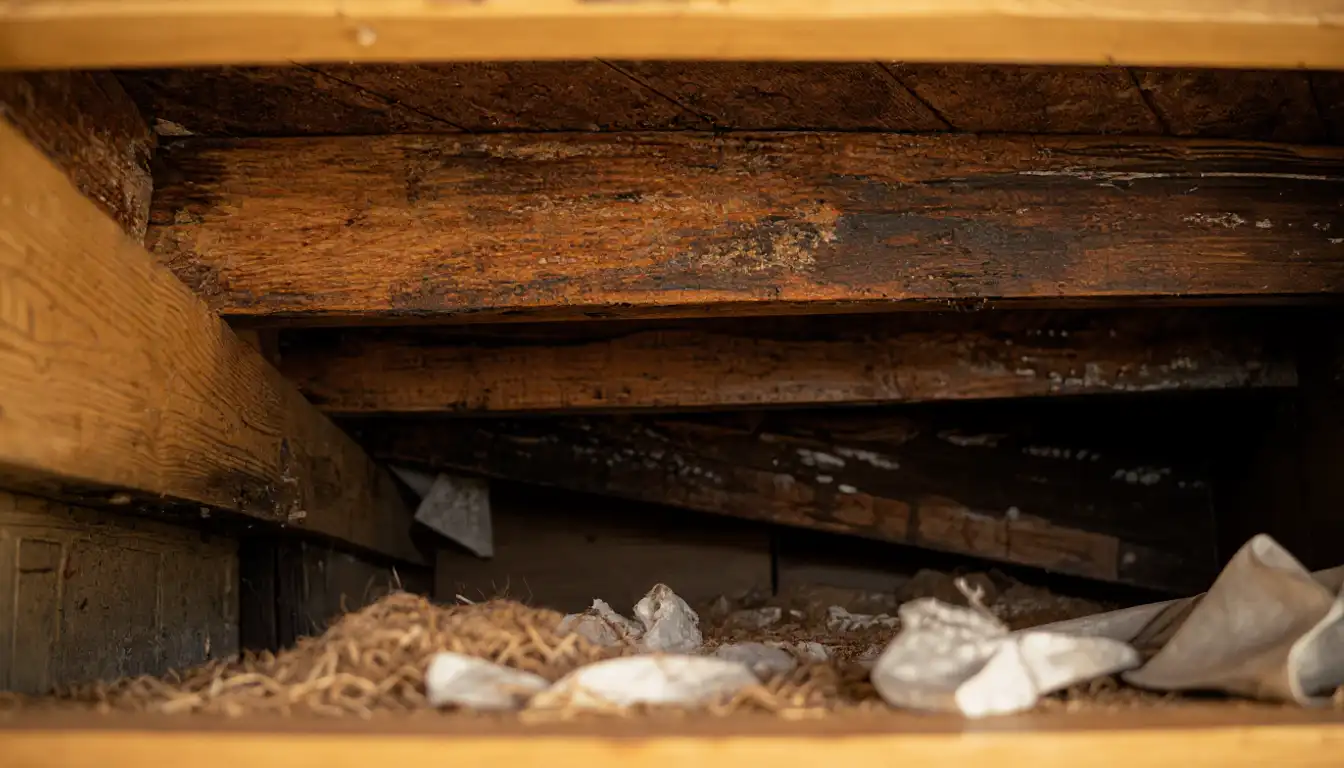
| Visual | Dark staining, mold growth, swollen/warped wood, white or brown fibrous material on surfaces | Surface fungi confirm moisture conditions; fibrous material = active decay fungi |
| Screwdriver probe | Press a flathead screwdriver firmly into wood. Focus on bottom edges and ends of joists, sill plates. | Healthy wood resists penetration. Decayed wood lets the blade sink in easily — sometimes 1+ inch. |
| Moisture meter | Insert pins into joists at multiple locations. Record readings. | Below 15% = dry. 15-20% = elevated. Above 20% = decay conditions. Above 30% = rapid deterioration. |
| Deflection check | Have someone walk above while you watch joists from below | Visible flexing indicates reduced stiffness from cross-section loss |
| Pest evidence | Mud tubes (termites), fine sawdust/frass (carpenter ants), insect activity on joists | Moisture has attracted wood-destroying organisms — additional damage pathway. See pest intrusion page. |
Section 5 of 7
Structural Repair Options
Critical principle: Fixing structural damage without controlling moisture guarantees the new or reinforced members will eventually suffer the same fate. Moisture control and structural repair are complementary — neither is complete without the other.
| Method | When to Use | How It Works |
|---|---|---|
| Joist sistering | Moderate damage — surface decay or partial cross-section loss | New full-length joist bolted alongside damaged one, restoring load capacity |
| Support jacks | Multiple joists sagging over the same span; mild-to-moderate deflection | Adjustable steel columns on concrete pads provide mid-span support; can level floors |
| Joist replacement | Severe rot — wood soft and crumbling through more than half the cross-section | Damaged joist removed and replaced; requires temporary support during work |
| Sill plate repair | Rot at the foundation-sill connection affecting bearing for perimeter joists | Damaged sections replaced with pressure-treated lumber after temporary joist support |
| Subfloor replacement | Plywood/OSB panels above joists have delaminated from moisture absorption | Damaged panels cut out and replaced; requires removing finish floor in affected area |
For a broader view of structural repair methods and how they fit with moisture control systems, see our structural repair methods page. Our cost and ROI guide covers investment ranges.
Section 6 of 7
Moisture Control: Preventing Future Damage
Every repair method above is temporary without moisture control. The science is well-established — reduce humidity below 60% and wood moisture content drops below the 20% decay threshold.
| Intervention | What It Addresses | Impact on Wood Moisture |
|---|---|---|
| Vapor barrier over soil | Ground moisture — 10-15 gal/day from exposed soil | Reduces largest moisture source by 90%+; biggest single impact |
| Seal foundation vents | Summer humidity influx (77% avg RH enters through vents) | Eliminates seasonal humidity spikes that reactivate decay |
| Dehumidification | Residual moisture from concrete walls and seasonal fluctuation | Maintains 45-55% RH year-round; wood MC drops to 10-14% (kiln-dried range) |
| Full encapsulation | All moisture pathways in one integrated system | Transforms crawlspace from damp environment to dry, conditioned space |
The Advanced Energy study found sealed crawlspaces maintained 52% average RH vs. 77% in vented crawlspaces. At 52%, wood moisture content settles between 10-14% — the same range as kiln-dried lumber. Both existing framing and new repair members remain sound. Moisture control also reduces pest risk by making wood less hospitable to termites and carpenter ants.
Section 7 of 7
What to Document Before Calling a Professional
Documentation Checklist
- ☐ Floor problem locations — Map which rooms have bounce, soft spots, or visible dips. Mark specific areas.
- ☐ Sagging vs. sloping — Localized bounce (joist damage) or consistent tilt (foundation settlement)? Do the marble test.
- ☐ Timeline — When did you first notice? Has it been getting worse? How quickly?
- ☐ Crawlspace access observation — Can you see sagging insulation, visible mold, dark staining on wood, standing water?
- ☐ Screwdriver test — If accessible, probe several joists and sill plates. Note where the blade sinks in easily.
- ☐ Humidity reading — Place a hygrometer in the crawlspace for 48 hours.
- ☐ Other symptoms — Musty smell? Cold floors? Pest evidence? Visible mold? All confirm moisture-driven root cause.
- ☐ Home details — Age, crawlspace type (vented/sealed), prior repairs or improvements.
Related Symptoms
Sagging floors are a later-stage indicator of crawlspace moisture problems. These symptoms often appear alongside or before floor damage:
- Crawlspace Mold — The same humidity that feeds decay fungi sustains mold colonies on the same wood surfaces
- Pest Intrusion — Termites and carpenter ants target moisture-softened wood, compounding structural damage
- Musty Smell — Often the first noticeable sign of the moisture problem causing joist damage
- Cold Floors — Degraded insulation from the same moisture conditions that damage joists
- Complete Crawlspace Guide — Full overview of crawlspace conditions and improvement methods
Frequently Asked Questions About Sagging and Bouncy Floors
Bouncy or springy floors often indicate that floor joists have lost structural integrity, typically from moisture-induced wood fiber degradation. When wood moisture content stays above 20% for extended periods, decay fungi break down the cellulose fibers that give joists their load-bearing strength. The result is a joist that flexes more than it should under normal foot traffic. While a slight bounce in a long-span floor can be normal, increasing bounciness — especially in areas near bathrooms, kitchens, or exterior walls — suggests progressive structural member cross-section loss that warrants inspection.
Sagging floors dip or feel soft in localized areas, usually in the middle of a room or along specific joist runs. This pattern points to weakened or damaged floor joists beneath those spots. Sloping floors tilt consistently toward one side or corner of the house, which typically indicates foundation settlement — a different structural issue involving the foundation walls or footings shifting downward. The distinction matters because the causes and repair methods are entirely different: joist damage requires crawlspace-level structural repair, while foundation settlement requires foundation-level intervention.
It depends on the extent of the damage. Joists with surface decay or moderate cross-section loss can often be reinforced through sistering — attaching a new full-length joist alongside the damaged one to restore load capacity. Joists with severe rot, where the wood is soft and crumbling through more than half the cross-section, may need full replacement. Sill plates with localized rot at the foundation connection can sometimes be repaired in sections. In all cases, the moisture source must be addressed first, or the new structural members will eventually suffer the same damage.
A visual inspection from inside the crawlspace can reveal common signs: dark staining on wood surfaces, visible mold or fungal growth, wood that appears swollen or warped, and white or brown fibrous material on joist surfaces (indicating active decay fungi). You can also press a screwdriver into the wood — healthy joists resist penetration, while decayed wood allows the blade to sink in easily. A pin-type moisture meter provides precise readings; wood moisture content above 20% indicates conditions favorable to decay. Pay special attention to sill plates where joists meet the foundation wall, as these areas collect moisture first.
Crawlspace encapsulation addresses the moisture conditions that cause joist damage in the first place. By sealing the crawlspace with a vapor barrier over exposed soil, closing vents, and controlling humidity with a dehumidifier, encapsulation reduces relative humidity from the 70-80% range common in vented crawlspaces down to 50-55%. At these levels, wood moisture content drops below the 20% threshold where decay fungi can grow. Research from Advanced Energy found that sealed crawlspaces maintained average humidity of 52% compared to 77% in vented crawlspaces. However, encapsulation prevents future damage — it does not reverse existing structural damage, which requires separate repair.